Why Programmatic CTV Advertising Is a Must for Healthcare Marketers
Streaming has permanently reshaped how audiences consume television, and it has permanently reshaped how healthcare marketers should reach them. Programmatic CTV advertising combines the storytelling power of TV with the targeting precision and real-time optimization that digital makes possible. Here is what that means for your campaigns.
Streaming is now how most Americans watch television. Connected TV (CTV) ad investment in the U.S. reached $21.45 billion in 2024, a 16.2% jump fueled by the continued migration of audiences away from linear TV and onto streaming platforms. Programmatic execution now accounts for 75% of CTV transactions, and 95% of advertisers plan to sustain or increase their CTV budgets going forward.
For healthcare marketers, the shift to streaming is an opportunity to reach HCP and patient audiences with a level of precision, efficiency, and measurement that linear TV has never been able to offer.
What Is Programmatic CTV Advertising?
Connected TV (CTV) refers to any television that connects to the internet to stream content. Think: smart TVs, streaming devices like Roku and Amazon Fire TV, gaming consoles, and similar hardware. The audiences watching Netflix, Hulu, Peacock, Disney+, and the growing ecosystem of free ad-supported streaming (FAST) channels are CTV audiences.
Programmatic CTV advertising is the automated, data-driven method of buying and delivering ads within that streaming environment. Rather than negotiating fixed placements with networks in advance, as in traditional linear TV buying, programmatic uses real-time bidding and audience data to serve ads to specific, defined audiences at scale, across multiple streaming platforms simultaneously.
The result is a channel that looks and feels like television but operates with the targeting precision, real-time optimization, and performance measurement of digital. For healthcare advertisers, that combination is particularly powerful, and the implications for both HCP and DTC campaigns are significant.
Why Programmatic CTV Works Better for Healthcare Marketers
Linear TV has long been one of the largest line items in pharma marketing budgets. The reach is real. But so are the limitations: broad demographic targeting, no real-time optimization, and measurement that tells you how many people might have watched, not how many were actually relevant to your brand. Programmatic CTV solves each of these problems in ways that matter specifically to healthcare advertisers.
Precision That Goes Beyond Age and Gender
Linear TV targeting is built on demographic proxies: age, gender, household income, and broad audience segments derived from viewing behavior. For healthcare campaigns, these attributes are a poor substitute for clinical relevance. A 55-year-old male watches the same sports programming whether he has been diagnosed with Type 2 Diabetes or not.
Programmatic CTV breaks that limitation. Healthcare-specific audience data, drawn from real-world clinical sources including diagnosis codes, prescription claims, and NPI-verified prescriber profiles, enables advertisers to reach people based on their actual health context. For DTC campaigns, that means finding verified patient audiences: people who carry the relevant diagnosis, not people who demographically resemble them. For HCP campaigns, it means reaching the specific prescribers most relevant to a brand by specialty, prescribing history, and patient panel characteristics.
That precision changes the economics of CTV entirely. When every impression is more likely to land with someone who is clinically relevant to your brand, the efficiency of the buy improves dramatically, and so does the downstream impact on scripts and patient starts.
Cost Effectiveness
The case for programmatic CTV's cost efficiency in healthcare comes down to a simple principle: you are not paying for reach you cannot use. Linear TV buys broad household audiences and accepts that a large fraction of those impressions will never be relevant to the brand being advertised. For pharma campaigns, where the indicated patient population is often a small percentage of any given demographic group, that waste compounds quickly.
Programmatic CTV lets healthcare marketers allocate budget against verified audiences — people who are measurably more likely to be relevant to the campaign. The result is a lower effective cost per meaningful impression, even when CPMs appear higher than a comparable linear buy. When you measure cost against qualified audience delivery rather than raw household reach, programmatic CTV consistently outperforms linear alternatives.
Data-Backed Campaign Optimizations in Real Time
One of the most significant structural limitations of linear TV advertising is its inflexibility once a campaign has launched. You negotiate a buy, produce creative, and run it. If something is not working (if a certain daypart is underperforming, if a creative unit is not resonating), there is limited ability to intervene until the flight ends.
Programmatic CTV operates on a fundamentally different model. Between audience targeting, media placements, creative rotation, and frequency management, there are dozens of campaign parameters that can be adjusted in real time. Machine learning algorithms continuously analyze performance signals and optimize toward the metrics that matter. For healthcare campaigns, that means audience quality and script performance rather than generic video completion rates.
For any programmatic CTV campaign, the ability to see what is working mid-flight and adjust accordingly is one of the most powerful advantages the channel offers over anything linear TV can provide. Campaigns improve as they run, not only after they end.
Better Engagement Rate
Streaming audiences are engaged audiences. The lean-back, full-screen viewing environment of CTV, typically on a living room television, creates conditions for advertising attention that are difficult to replicate in other digital formats. CTV ads are typically non-skippable, full-screen, and served within premium content environments with low ad loads compared to linear TV.
For healthcare advertising, where creative often needs to carry significant information, including fair balance risk disclosures for prescription drugs, the longer-form, high-attention environment of CTV is particularly well suited. A 30- or 60-second unit in a streaming environment can deliver the complete clinical story that a short-form digital format simply cannot accommodate. The combination of high attention and adequate time is what makes CTV uniquely effective for pharma creative.
Incremental Reach Linear TV Cannot Deliver
Linear TV's audience has been declining for years, and the trajectory has only accelerated. Cord-cutting continues to grow, and a meaningful segment of the population, particularly younger demographics, has never had a cable or satellite subscription at all. These audiences are invisible to linear TV campaigns, regardless of how the buy is structured.
Programmatic CTV reaches these cord-cutters and cord-nevers where they actually watch television: on streaming platforms. For brands that rely heavily on linear TV, a significant and growing portion of their potential audience is simply unreachable through existing buys. CTV is the only way to reach audiences that linear TV has already lost.
CTV is on track to officially surpass linear TV spend in the healthcare category by 2028, following years of double-digit annual growth. Brands that have already made the shift will have a meaningful head start.
Optimizing Your Programmatic CTV Campaigns
The effectiveness of a programmatic CTV campaign is not determined at the point of activation. It is determined by the quality of the audience data you start with, the rigor of the optimization infrastructure you run on, and the measurement framework you use to evaluate outcomes.
On the audience side, programmatic CTV lets healthcare marketers leverage real-world clinical data, NPI lists, and first-party data to build campaign-specific HCP and HIPAA-compliant patient audiences. These audiences are fundamentally more refined than the demographic attributes that underpin linear TV planning. That precision is what makes the optimization that follows meaningful rather than mechanical.
Once a campaign is live, machine learning algorithms can take millions of audience, media, and messaging signals into account simultaneously, continuously reallocating toward the placements, audiences, and creative executions that are driving the best results. The algorithms self-improve as the campaign runs, which means campaigns launched with the right foundation tend to perform better at the end of the flight than at the beginning.
Critically, the right optimization target for a healthcare CTV campaign is not video completion rate. It is audience quality and script performance, the metrics that are directly tied to commercial outcomes and better patient results. General-purpose optimization toward engagement proxies leaves significant performance on the table. Healthcare-specific optimization toward outcomes is what separates an efficient CTV campaign from a truly effective one.
Looking Beyond the Buy
Campaign data does not stop being valuable when the flight ends. The performance signals generated by a programmatic CTV campaign (audience quality data, geographic script volume, creative performance by segment, HCP engagement patterns) are inputs that can inform every future media decision a brand makes.
Consider a campaign for a Type 2 Diabetes treatment. Analyzing script volume by geography, a brand might notice a meaningful difference in prescription activity between two markets that are geographically close but demographically distinct: a retirement-heavy community with a high prevalence of older patients versus a younger urban population where the condition is less common. That geographic performance signal can directly shape how future media buys are planned, weighted, and targeted.
This kind of forward-looking analysis is what keeps campaigns on a trajectory of continuous improvement, building institutional knowledge about where the brand's audience lives, how they respond to specific creative approaches, and which market conditions produce the strongest commercial outcomes. The data generated by a well-run programmatic CTV campaign is one of the most underutilized strategic assets in pharma marketing.
What a Healthcare-Native Programmatic CTV Platform Can Do For You
Not all programmatic CTV platforms are built for the complexity of healthcare advertising. General-purpose DSPs were designed for consumer advertising, and adapting them to meet pharma's requirements (HIPAA-compliant audience infrastructure, real-world clinical data integration, outcomes-based measurement, NAI-standard data handling) is a fundamentally different challenge than the platforms were engineered to solve.
A healthcare-native programmatic CTV platform does things a general-purpose DSP cannot. It connects directly to clinical data sources to build verified HCP and patient audiences. It handles audience construction through HIPAA-compliant workflows by design rather than by workaround. It measures campaign performance against pharma-specific outcomes like script lift, patient starts, and new-to-brand prescribers rather than generic digital KPIs.
What sets programmatic CTV apart for healthcare is the data layer that sits beneath the buy. When clinical data refreshes daily, marketers can see the downstream impact of their CTV campaigns on prescribing behavior while the campaign is still running, not weeks after it ends. That real-time feedback loop is what enables the kind of optimization that moves commercial outcomes.
The right healthcare CTV platform goes further than placing impressions on streaming platforms. It connects those impressions to clinical outcomes, giving your team the insight to optimize toward what actually matters for your brand and your patients.
Put Programmatic CTV to Work for Your Healthcare Campaigns
The case for programmatic CTV in healthcare has moved well past the experimental phase. With CTV investment in the U.S. exceeding $21 billion and programmatic execution accounting for three-quarters of CTV transactions, the channel is now a core part of how sophisticated healthcare advertisers reach both HCPs and patients.
The brands seeing the strongest results are those that have paired the channel with the right infrastructure: verified clinical audience data, HIPAA-compliant targeting workflows, outcomes-based optimization, and real-time measurement against pharma-specific KPIs. That combination is what turns a CTV buy into a measurable driver of script lift and patient starts.
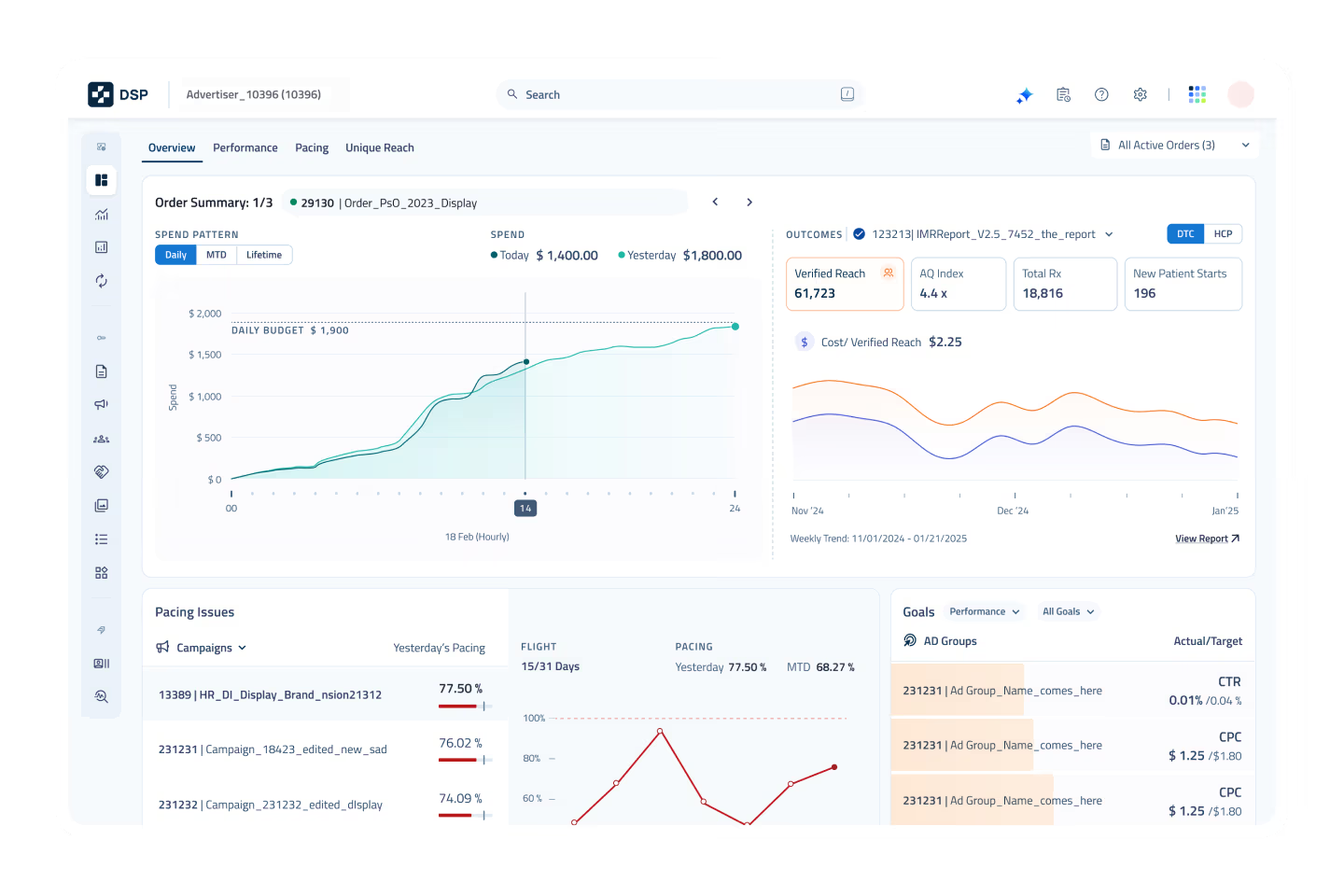
DeepIntent's purpose-built healthcare DSP connects programmatic CTV to the clinical data, compliance infrastructure, and outcomes measurement that pharma campaigns require. From audience construction through real-world clinical sources, to omnichannel activation across all major streaming platforms, to daily-refreshed script lift reporting, the platform is built to do what general-purpose CTV platforms cannot.