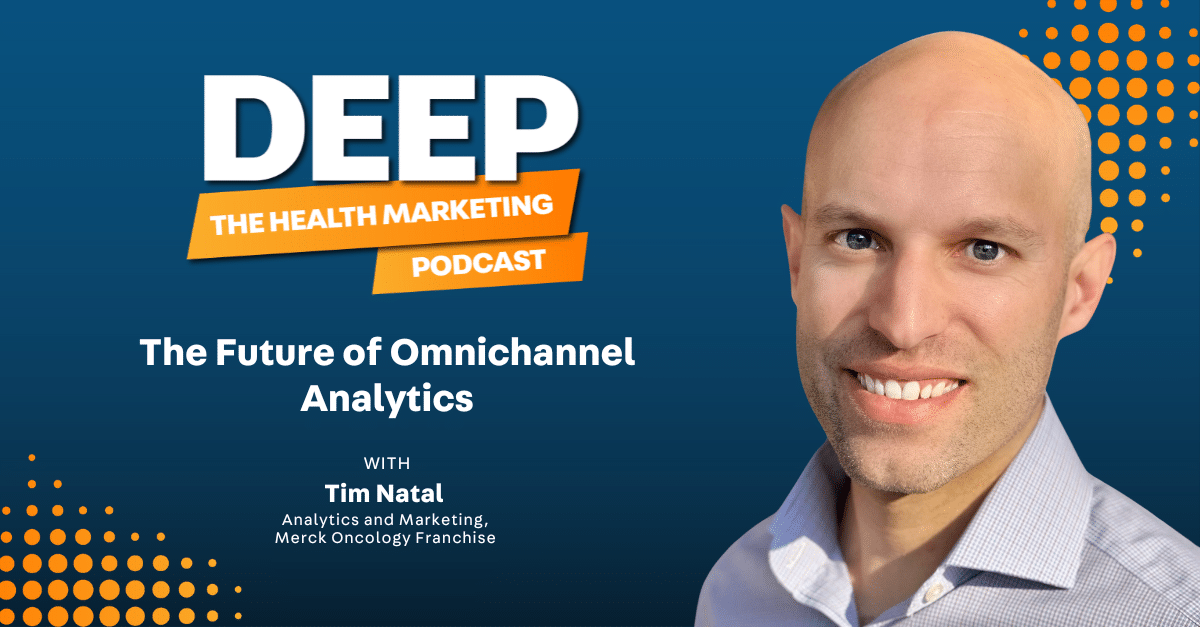
In this episode of Deep, John Mangano chats with Tim Natal, who oversees analytics and marketing within Merck's oncology franchise. Tim shares his journey to his current role where he integrates data, media, and analytics to improve patient outcomes. He highlights the profound impact of campaigns in getting patients on the right therapies and how Merck is preparing for future changes in technology and regulations. Together, Tim and John also explore the potential of underutilized channels like connected TV (CTV) and the promise of creative messaging that resonates with patients, among other key industry ambitions.
Transcript:
John Mangano (JM): Audience, are you guys ready to podcast? Woo — that's right, that's right. Alright, let's go, let's see how this works.
So this is the first recording in front of a live studio audience. Welcome to the Deep Intent Podcast, where we go deep on how patient health can be improved through marketing and technology. Our guest today is Tim Natal. Tim comes to us from Merck, where he's spent many years — his career is long and storied in the pharma space. He started at SDI, which ultimately became IQVIA on the data side, and then moved over to the brand side at AstraZeneca and, more recently, Merck. Welcome, Tim.
Tim Natal (TN): Thanks, John. Really happy to be here — excited to be on this podcast.
JM: Great. So you have a very cool role — you're basically managing analytics and marketing for the oncology franchise.
TN: Yeah, I've been with Merck for about 18 months or so. My role is really around roadmapping for our consumer marketing analytics within oncology — thinking through new capabilities and where we want to go as the landscape evolves and our products evolve.
JM: You're in oncology, and we talk a lot about how marketing can help patient health — but in oncology, you pretty much know that if your brand is successful, you're saving lives. Did you think you'd be doing this when you were a young Tim Natal just starting your career? How did you get here?
TN: It's funny — I'd never really thought about pharma, even in college. I graduated in 2008, and if you remember 2008, it wasn't the best time to graduate. But a small company called Verispan hired me about two weeks before graduation, which then became SDI, and later IMS.
I really got into the marketing analytics space shortly after joining IMS. They had this "consulting fundamentals" course where I got to meet people from across the company, and a few of them were on a team called Consumer Insights, Marketing Effectiveness, and Media Innovation. I remember thinking, "What is that?" As I learned more about them over a couple of days, I got really intrigued. They had an opening, I applied, got the role, and just dove in.
It was really cool to see how data, media, and analytics could all come together. There was one early project I worked on for a TV campaign, and what really hooked me wasn't just the analytics and the data behind it, but the profound impact we saw — being able to get patients onto the clinically appropriate therapy. From there, it just took off for me — constantly trying to innovate and find new ways to grow those parts of the business, or help brands and marketers figure out the best way forward. And the landscape has kept evolving.
JM: What does your day-to-day look like, and how do you optimize and improve performance at Merck?
TN: A lot of it is stakeholder management — making sure all the different connection points we have for analytics, whether that's agency partners or internal marketers, stay aligned. And making sure that as we optimize in this changing landscape, we're not just thinking about right now and today, but also planning a year or more down the road.
JM: So much change is happening right now — I think this might be the biggest year of change since the early days of the internet. Everything going on today could basically rewrite how we do things. What's the most impactful shift you're planning for, and what do you think will really impact our day-to-day?
TN: There are really two things I think about, from an analytics, measurement, and marketing perspective. First, the deprecation of cookies, and making sure we can continue to measure our campaigns once they're gone. Second — and happening at the same time — a lot of the legal changes we're hearing about from different states, and how those laws impact our current campaigns and content. It's really exploded just in the last month or so. Fortunately, a lot of the work we've been doing to prepare for this, and having a forward-looking vision, has put us in a pretty good spot already.
JM: What do you think the real-world impact will be? We always talk about this in terms of marketing plans and the business we manage, but in the end it's about patients. Do you think these changes will make things better for patients? Will they still get treatment at the same rate as today? Is there a risk here? What do you think the actual outcome will be?
TN: I think we can still have the same impact we've had on patients. We're going to have more data available to us than ever before, and there's this convergence happening around understanding our customers — whether that's an HCP or a consumer. As things have changed, we've continued to innovate — whether that's technology companies, data companies, or marketers ourselves — and we've always found a way to keep growing. I think we're in a great position to do it better than ever.
JM: What's keeping you up at night?
TN: Probably that we're not moving fast enough. Pharma has traditionally lagged a bit behind other industries. So as long as we keep pushing with our internal stakeholders and client partners, that's where I think we need to focus. In these large organizations I've been part of, things sometimes take longer to happen than they should. So I'm constantly thinking about how we manage change, what the new world will look like, and making sure we're on track to meet our customers where we need to.
JM: If you could make three things happen faster, what would they be?
TN: A full, universal solution for cookies, where everybody's on the same page, would be wonderful. Having all states adopt the same rules would be nice too — I don't think that's going to happen, but at least having some kind of overarching clarity on what the privacy landscape is going to look like. And I'd say more consistent analytics than we've had before.
JM: So what's working well today?
TN: I'd point to how far we've come in terms of connecting different data points. We're all still figuring it out, but I've seen a real jump in the last four or five years in our ability to make connections we couldn't make before, and to get more data internally instead of always relying on partners. Partners are still important and a big part of the puzzle, but it's about making sure we have the measurements we need while also looking toward the future.
JM: Do you think that's going to change in the short term, given the shifts in tech and privacy?
TN: Yeah, we're already seeing it. A lot of partners that relied on cookies before have already started shifting — or we've shifted to partners that don't rely on them. We've seen changes on our own internal platforms too, as the laws change. So the impact is already happening today, whether or not cookies fully disappear by the end of the year. My job is to make sure we have something in place now, rather than waiting for that to happen.
JM: So are we going back to 1999?
TN: I don't think we're going back to 1999. People talk about contextual targeting and things like that, and maybe some of that resurfaces, but from a measurement standpoint, I don't think so. Our ability to connect data points, from a privacy-compliant perspective, has grown more in the last 12 months than I expected.
JM: I think there's also a lot of opportunity in other tech. When I look at AI — while there's a ton of talk about it — I think, as an analytics person, it opens new doors. Even if I end up with less raw data because of cookie changes, I have a lot more tools to apply and get insights from what I do have.
TN: Absolutely, I completely agree. Over the last 12 to 18 months, everyone's been talking about AI — what it means for our organization, how our partners and technology platforms are or aren't using it, where we can build in efficiencies. And when we do have less data than before, how do we use these tools to make sure we're still meeting our patients where they need us?
JM: There's a lot of talk about solutions out there. What are the "red herrings" you see — things you don't buy into, or that distract from where we're actually trying to go with all these changes?
TN: I don't know if "distraction" is quite the right word, but in pharma, we've traditionally held onto measurement approaches that are correlation-based rather than causation-based. Marketing mix modeling, for example — we've been doing that forever, and it takes forever to run. Internal stakeholders end up waiting on results to make decisions about something that happened 12 months ago. For me, the opportunity is that we now have the ability to go deeper and get faster results, so we can pivot and understand how campaigns are performing on a much more causal basis than before. That's one of the things that still drives me a little nuts.
JM: Let's go deeper on that. What would you use instead of marketing mix modeling to get faster, better insights?
TN: You can look at weekly or monthly conversion metrics from a platform connecting media campaigns to patient data — that's a shorter-term optimization approach a lot of us have adopted. I also think more design testing helps — setting up campaigns across channels, not just display, online video, or endemic, but looking at how all these channels interact and drive business impact within three to four months. Then you can understand: if I had another dollar to spend, where would I put it? I've seen and been part of ways to do that more quickly, and that's where I'd love to see more people go — utilizing platforms that can bring together the data we need for that kind of analysis.
JM: What technology platforms excite you right now?
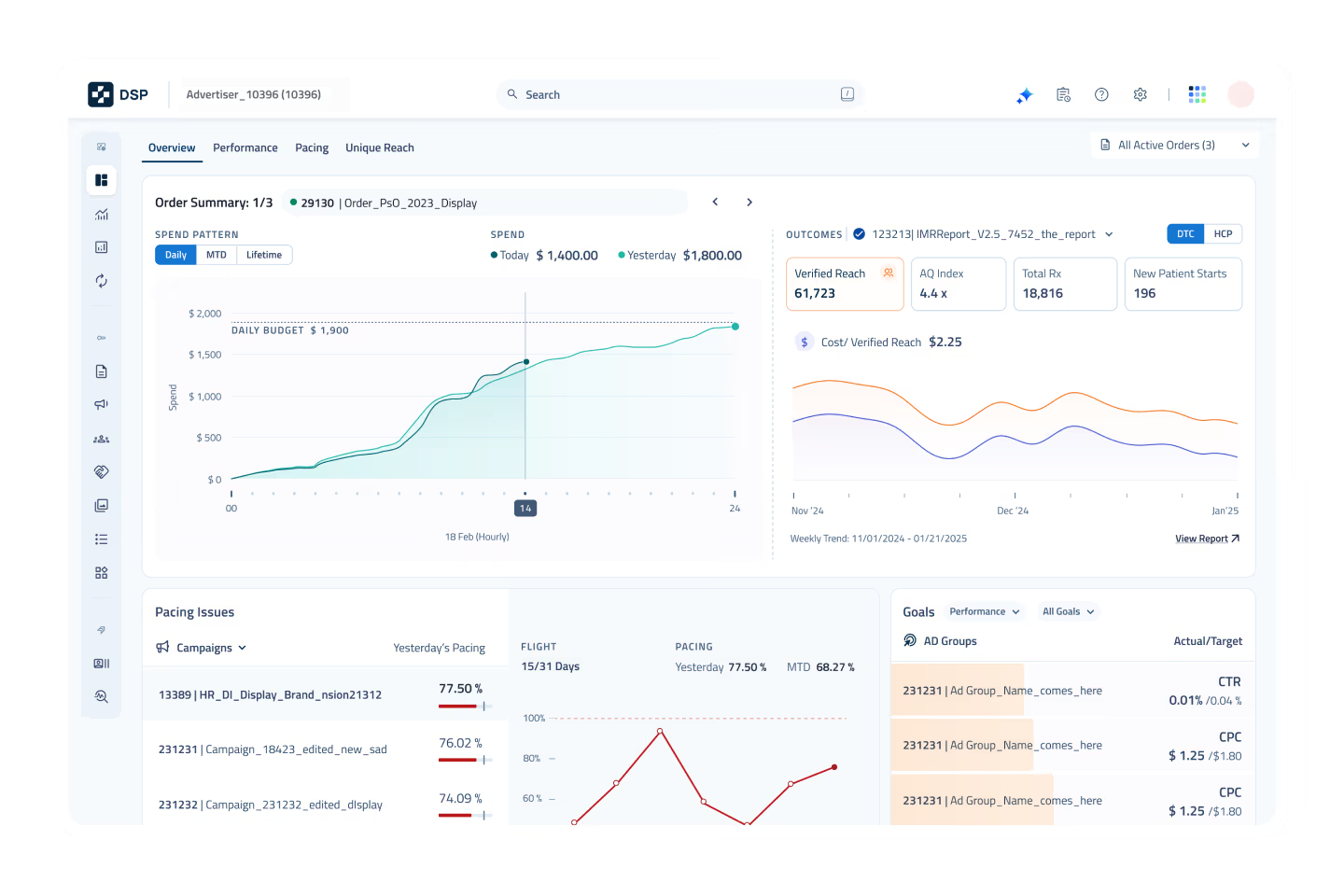
TN: There's a lot happening around connecting what we see from a DSP with our DMPs, our CRMs, and safe havens — running analytics within those platforms and bringing in patient longitudinal data. Those connections have existed in some form before, but identity graphs are more connected now than ever. Once you start layering AI on top of that, that's where it gets exciting — not just in terms of automating work, but getting better at understanding how customers are actually interacting with our content, learning from that directly instead of just assuming how we think they should interact with it.
It's also about getting better across brands, not just within one. In pharma, a lot of us get assigned to a single product, but as an organization we have multiple products, often trying to reach the same consumers or similar HCPs. Getting better at understanding, across all of them, who should be reached and how often, is a big opportunity — one a lot of us aren't doing particularly well at right now.
JM: Are there any underutilized channels you think could be "reborn" with the changes we're seeing — a new way to approach patients or HCPs that we haven't really focused on?
TN: Let me think... I'm a bit of a TV geek — I started my career doing a lot of TV campaigns, as I mentioned earlier — and CTV, I still think, is widely underutilized compared to where we traditionally put our media dollars. It opens up a lot of opportunity for brands that maybe thought they couldn't do TV before, because it used to require a huge budget. Now you can buy it programmatically, connect it with the other channels and segments we're already running in the programmatic space, and get data back — which is huge. It's been growing year over year, but I still think there's a lot of room for it to grow further.
JM: When we look at TV creatively, are there new opportunities? I feel like we often see the same ad with the same message — and yes, there are good legal reasons for that — but outside of those constraints, is there another direction that messaging could take, or are we pretty much where we're going to be with the message to patients?
TN: I hope we're not where we need to be yet. Not just with TV, but across a lot of channels — consumers expect to engage with certain platforms and content in a certain way, and then we come in and have to satisfy the ISI and all the legal requirements. I think there are better ways to create content that reflects the platform or space it's in, and that can be more engaging. So I do think there's room for improvement. I'm not a creative whiz by any stretch, but I think it can evolve, and I think it will.
JM: What excites you most about tomorrow, with all the changes and new tech we're seeing?
TN: What's exciting is that all these changes — cookies, regulation, and AI on top of that — are pushing everyone to be more innovative and find new solutions. That breaks a lot of the old, traditional ways we've had to think about measurement and optimization, which has been exciting to be part of. Some of the things I might want to do, we'll realize just aren't available anymore, so we have to move to something new. That's actually a great opportunity to think differently about what we might be missing, and what new paths we should be exploring.
JM: You mentioned earlier that pharma tends to lag a bit behind other industries, but I actually think it's often the opposite. We have better data than almost any other industry, just given how it's collected — insurance, and everything else involved. I feel like we're almost ahead in some ways. When you compare what we do to, say, CPG or other categories, does this give us an opportunity to take marketing as a whole to a new level? We often feel behind, but in some ways we're actually trailblazers — we're more sensitive to privacy than almost any other industry. And as new privacy laws get created, this is brand-new territory for the auto industry and others, but we're kind of old hands at it. Do you think that gives us an advantage as marketers, and opens up something even more interesting for the future?
TN: We definitely have to think outside the box because of restrictions that other industries don't necessarily face, and I think that gives us a leg up in the sense that we've already been dealing with this for years and know how to handle it. The path to getting someone onto a treatment inherently takes longer than, say, a CPG purchase — you can see a Coke commercial and go buy a Coke down the street. We can't do that in pharma; it's much harder. So I think you might be right that some parts of how we approach new rules put us ahead. That said, I do think there are other industries using tech stacks that are probably more advanced than ours in some areas — but I think we can look to them for examples, and maybe they can learn something from us too.
JM: Definitely. There's a lot of change ahead — there always is — but we can see the direction it's heading. At some point cookies might go away entirely; we'll see when. But there are all sorts of other changes coming too. How do we stay ahead of this shifting environment? Ultimately, our plans don't really change — patients are still getting sick, and we still need to reach them with the right message and get them on treatment.
TN: This is where you have to constantly be testing and piloting new capabilities as things evolve. There's your day-to-day, but at the same time, you need to be thinking about what else you could implement to be ready for the next change. If you're just sitting back waiting to see what happens, that's not where I want to be — I'd rather already be ahead of it. If cookies don't fully go away by the end of the year and carry into next year, fine — how do we use that transition period alongside what we currently have, until they're gone? It's about maintaining a mindset of continuous evolution, not settling for what you already have. That mindset is what keeps us ahead.
JM: There are people in every industry — and definitely ours — who just sit back and wait for changes to happen before adjusting. What would you tell someone who just woke up and realized cookies are going away, the tech world is changing, and privacy regulations are shifting? What should they do right away to get prepared?
TN: I'd say start with a very strong pot of coffee.
But seriously — first, know that you're not alone. Pull together whatever subject-matter experts you have around you, reach out to your agency partners. A lot of partners have already started moving on this, so there may be parts of your business that have already been touched without you realizing it. Then sit down and roadmap a plan to make sure you can keep giving your business partners what they need, and figure out how to evolve appropriately — can you do anything internally? If not, what's the short-term step to get you to a place where you can? Then keep building from there. But yeah, if you've been asleep for the last four years, a lot has changed.
JM: What's the most exciting thing we could do over the next year — something different and exciting, beyond just reacting to changes driven by the tech that's out there?
TN: For the next 12 months, I'd explore new ways to use AI in the segmentation work we already do, and compare it to how we've traditionally done things. I think there are a lot of efficiencies to be found there, and a lot of partners are already using this. There's also AI for day-to-day work — automating tasks. But beyond everything we need to address from a regulatory and cookie-less perspective, I'd say: explore ways to push the limits while still meeting your privacy standards and your company's regulatory requirements — and make sure you're staying within those boundaries.
JM: Great. Well, thank you, Tim, for your insights. You've been listening to Deep, the podcast that goes deep into how health can be improved through healthcare marketing and technology. That's it.