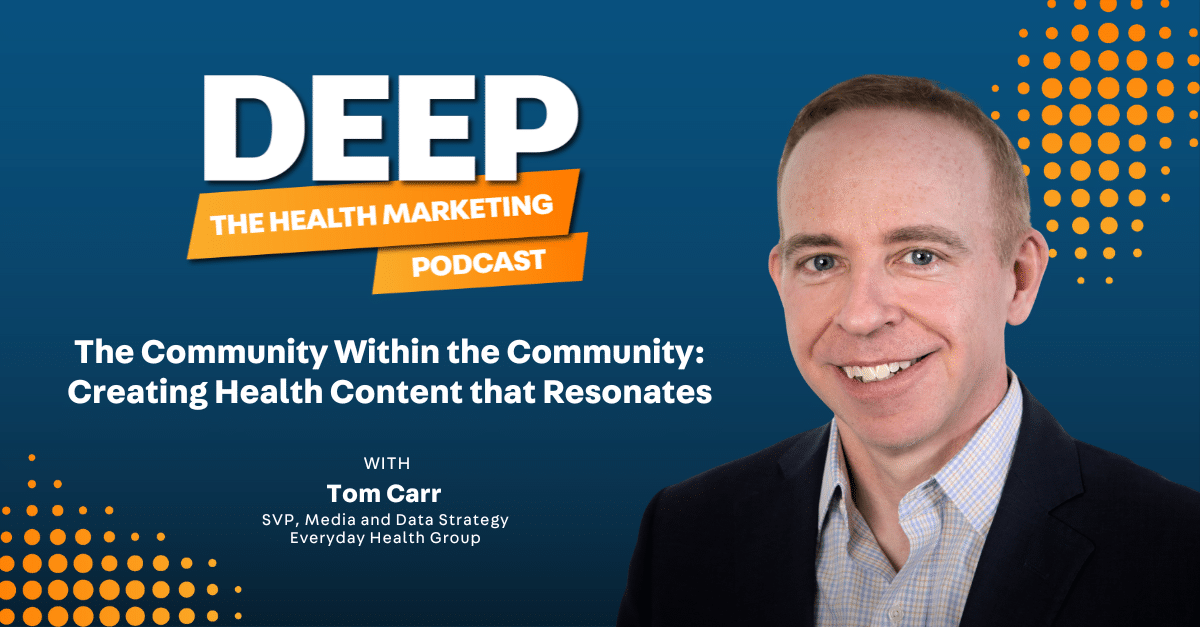
In this episode of Deep, John Mangano sits down with Tom Carr, SVP of Media and Data Strategy at Everyday Health Group, to discuss the evolution of health marketing and its impact on consumers and providers alike. Tom shares insights from his extensive career in health media, exploring how digital platforms have transformed patient engagement and healthcare communication over the years.
Tom delves into the critical role of personalized health content, highlighting why tailored messaging resonates more deeply with consumers and leads to better health outcomes. They discuss the importance of privacy in digital health experiences, the challenges and benefits of programmatic advertising, and the ways in which healthcare providers are using online resources to stay informed and better serve their patients. Tune in to learn about how healthcare leaders leverage data-driven strategies to create meaningful connections between patients, providers, and content—and why the future of health marketing lies in understanding each consumer’s unique journey.
Transcript:
John Mangano (JM): Welcome back to Deep. I'm John Mangano. Researching health conditions online has come a long way. Not that long ago, we were lucky to find any information on a condition, much less quality content — things have changed a lot. In this episode, we dig into online health research and how it's evolved: from a time when getting basic health information online was challenging, and often concerning, to today's world of more complex, one-to-one communication. This shift is creating new opportunities for more targeted, meaningful patient-provider discussions — but with those opportunities come real challenges.
Today I'm with an old friend, Tom Carr. Tom is SVP of Media and Data Strategy at the Everyday Health Group. Welcome, Tom.
Tom Carr (TC): Thanks, John. Great to be here, and great to see you.
JM: What we like to focus on in this podcast is how our industry affects people — but a big part of the industry is the people themselves. Tom, tell us a bit about yourself.
TC: I've been in the health vertical my entire career. I actually interned at Bristol-Myers Squibb back in college and caught the bug. Ever since, I've wanted to be part of this industry, because at the end of the day, we're really helping patients with their outcomes — that's incredibly important to me personally. Getting to be in this industry the whole time has been exciting.
JM: I know you do a lot of interesting things outside the office — you have a young family. What do you do for fun?
TC: One of the best parts of having two boys is getting to bond with them over sports. I was always into sports growing up, and I love nothing more than coaching both of them — baseball and basketball. Between that and all the practices, it's a handful, but it's exciting, and I love it.
JM: How old are your boys?
TC: Twelve and ten now.
JM: Wow, not so young anymore.
TC: They're getting up there — going on 25 in their own minds.
JM: I don't know — I look at my daughter at that age, and she was so much more mature and aware than I ever was. I think kids grow up faster now.
TC: No question.
JM: Beyond sports, what's most exciting for you to do with them as a family?
TC: It's funny — I have two boys raised the same way, and they turned out completely different. One's really into sports; the other is very into hiking and reptiles, which has been fascinating. What I love about experiencing things through their eyes is that you end up learning about things you never would have thought to be interested in on your own — but then your son gets into it, and you want to learn about it too, so you can talk to him about it. I'll shamefully admit I'm a huge Yankees and Giants fan, and at some point I'd stopped watching as much, thinking, "Why am I wasting time following people who don't care about me?" Then my kids hit a certain age and could rattle off every stat for every Yankee and every Giant, and I thought, "Wow, I need to start paying attention again." It's funny how things circle back around, as long as you give kids the space to learn and figure out life for themselves.
JM: When you said "ashamed," I thought you were going to tell me one of them turned out to be a Red Sox fan.
TC: No, that's not allowed in our household.
JM: The same thing happened to me, being a Floridian — football was always a big deal, and I went to a big football school. But I married a Canadian, so I basically stopped watching football entirely. Then, around sixth grade, my daughter said, "Can we just watch the Super Bowl? Everyone talks about it and I can't even follow the conversation." And I thought, "Oh God, it's been so long — I'm the worst football fan ever." But it was actually nice to get back into it.
TC: It reminds me of growing up watching football with my dad on Sundays. You don't want to force it on your kids, but when they're the ones coming to you asking to watch a Giants game, that's a powerful moment.
JM: And it's not so bad to get reintroduced to that old friend — a box of mac and cheese.
TC: There's nothing better than mac and cheese. Come on.
JM: Absolutely. So Tom, you've been in this space even longer than I have — actually, you're one of the first people I met when I started, back in 2008. You were an early media person in the health space at WebMD, and you've watched how patients use the internet, and how the industry communicates with patients online, evolve over time. What's changed the most since 2005?
TC: When everything first got going at WebMD — or at least when I joined in 2003 — reaching patients with the right messaging was the company's core goal. WebMD's mission was "better information, better health," and we believed in that strongly. We wanted to give patients all the information they needed to encourage positive health outcomes. Back then, we weren't being measured on success the way we are now, so there was a lot more room to experiment and try different marketing approaches. That's slowly evolved, and now you're held to a very different standard in terms of measuring campaigns and how those outcomes actually influence getting patients onto a prescribed treatment.
JM: Back in 2005, mobile web basically wasn't a thing yet — using the internet for everyday tasks the way we do today was still relatively new. How did patients interact with content back then, and are people using online health information more, less, or just differently now?
TC: Back then, we wanted the basics covered — condition guides, so if someone was looking for information on rheumatoid arthritis or anything else, they could find it on WebMD. What became clear over time was that there was a real thirst for more than just the typical article. So we started developing different ways of delivering content, along with tools and resources people could actually use in conversations with their doctor. That's really where things started to transform — opening up communication beyond just what someone reads on a screen, and helping them translate that into an actual conversation with their doctor.
JM: That was a wild time — we were still figuring out how to get any information onto the web, let alone health information. I remember it was around 2009 when the FDA finally started to recognize that the internet was a real channel for reaching patients, and that they probably needed to provide some guidance for brands marketing to them. How have brands changed how they communicate since then?
TC: That was definitely a tipping point for the industry. Pharma companies had to become very conscious of regulatory concerns. There was also a shift where pharma companies moved a lot of their campaign execution over to agencies, and specialized health agencies really started to build up their expertise. What we tried to do was meet in the middle — helping patients get the information they needed while helping pharma companies and their agencies run successful campaigns.
JM: I remember it being a real struggle — we were both in market research at the time, and we had to quantify and convince brands that the internet was a legitimate place to invest, competing against all the dollars going to TV. And to be fair, patients weren't all online the way they are now. But things have changed a lot. What shifts in pharma's attitude have you seen?
TC: There was the old "spray and pray" approach with TV — mass blanketing your message to as many people as possible, using demographic targeting and other blunt levers. What's really changed is access to information that lets you target the right consumer much more precisely. That evolution has continued over the past decade or so, and it's created real power on both the publisher/programmatic side and on the agency and client side, because you're now able to reach patients with the exact message you want them to receive, to help facilitate a productive conversation with their doctor. That's been one of the biggest — and most positive — shifts we've seen.
JM: Where do you think we go from here? What's the next thing, and what's likely to stay true through the future?
TC: One of the most exciting things about Everyday Health is our ability to create content that resonates with patients personally. I think that more personalized experience is exactly what patients want — just getting general information isn't enough anymore. We hear a lot in this industry about how clinical trials often fail to represent everybody they should, failing to capture how a drug might actually affect certain patient populations. It's the same with content consumption: if content doesn't speak to you specifically, it's essentially irrelevant, even if it might theoretically help you understand a condition. If you can't see how it applies to someone like you, or someone in your family, that's really what's been missing.
We put a lot of focus on understanding not just the broader community, but the community within the community. It's important to provide content that speaks not just to a general condition, but to that specific person — whether it's about them or a family member, they need information they can genuinely relate to. As we move toward more personalized content, that's where we see the greatest need, and what we're really trying to solve for — leading to more productive physician conversations and better outcomes for the patient.
JM: So what you're describing echoes a lot of what we keep hearing across the industry — that one-to-one messaging, tailored to who's receiving it, whether that's matched by gender or by someone who resembles the person hearing the message, might land better. Is that the direction we're headed, or is there more to it? Does the actual message itself change?
TC: That's exactly what I'm pushing for, and what our company is pushing for — having the messaging itself change. If you're reaching someone on a one-to-one basis, that's still just a one-to-one exchange; it doesn't guarantee the message actually resonates with that person. It might match their demographic profile, but what if someone is at a later stage of their journey versus someone newly diagnosed or just symptomatic? Sending them the exact same message isn't going to resonate, and it's not going to prompt a conversation with their doctor about a particular treatment. The message has to fit where they actually are, and what content they're consuming. That's really where the power of a publisher comes in — understanding what a patient is looking for, what content they're engaging with, and adjusting messaging not just to a patient population broadly, but to that specific person, based on where they are in their journey.
JM: That's a great point. In my market research days, I worked with a fertility brand to better understand what type of message resonated with someone based on their profile. Fertility treatment is something my wife and I actually went through, so I have some firsthand experience there. What was interesting was that people just starting that journey needed messaging that was emotional and sensitive — it's a hard, scary thing to face, wondering if you'll have a family at all. But once you go through the process — including things like giving yourself an injection for the first time, or, in my case, giving one to my wife, which is terrifying for everyone involved — the tone shifts entirely. The research found that people at the beginning of that journey needed real sensitivity, while people further along needed something much more clinical — almost devoid of emotion, just, "Here's exactly what you need to do next to reach the goal." How do you determine what stage of the journey someone is in, as an endemic publisher like Everyday Health?
TC: There are a lot of ways to approach that, but we always look for signals. The beauty of a site like ours is the data behind every page — and it's a privacy-safe experience; we want everyone to feel that privacy is protected. But understanding what someone is looking for, and then guiding them to what comes next, is incredibly important. If you put someone through a short assessment — a couple of questions — the more we understand about what they're looking for, the better we can tailor the information they need for a successful experience on our platform. That's true whether it comes from behavioral signals or direct questions we ask. None of that is about us extracting information for our own purposes — it's about giving people a better overall experience.
You mentioned your market research background — I actually started in market research too, and that experience really helps here, because it's not just about asking a question, it's about how you ask it, and how you follow up with the right materials to support that better experience.
JM: Do you find people are hesitant to respond to personal or potentially private questions on your site, or are people pretty open, since they're there anonymously?
TC: What I learned early in my career is that when people are talking about their health, they're often looking for an outlet — someone to talk to — and a survey can serve that function too. If you're gathering qualitative responses about how someone feels about the care they're receiving, or the lack of care, and what might help them, people often end up pouring their hearts out. It's more than just getting a response — people are almost oversharing, to some degree, and you have to be careful about that, since you don't want to hold onto sensitive personal information that could be harmful to them. You want to help that person, and sometimes they just need to talk about it. Those are exactly the people we most want to help, and that's part of why I love working in this vertical.
JM: I think people forget that health is a very private topic, and there's a lot people won't discuss even with friends at the office water cooler. It's also full of rare conditions, so in many ways there's no built-in community to talk to — if you have something no one you know has ever heard of, it's hard to even start that conversation. The internet is wonderfully private, and unfortunately that same privacy also enables less great things — fraud, certain crimes, and so on — but that privacy is exactly what makes it so well suited for health. Anyone can go to a website, even join a community, and talk about their condition, and the reality is no one will know who you are. If you have something rare, you might find 2,000 other people across the country to share experiences with — something you'd never get in a traditional public setting.
TC: One thing we noticed early on, when mobile was first gaining popularity for accessing health sites, was that certain conditions — mental health being a big one — saw a much higher volume of visitors on mobile devices versus desktop. As you said, people really wanted a private experience, and even within your own household, you probably don't want others seeing what health topics you're browsing. A mobile device added another layer of privacy, so people felt more comfortable engaging online, versus a shared household computer. That's evolved a lot over the years, but early on, it was something that really caught our attention as we tried to understand user behavior.
JM: And it's still the internet — it used to be called the "Wild West," and it's still pretty wild in some ways, even around health content. We saw a lot of that during the pandemic. What can the industry do to make sure content is truthful and of a quality people can actually trust for health decisions?
TC: It's important to have medically reviewed content — that's something we really pride ourselves on at Everyday Health. Every piece of content we publish is verified by our health expert network, a whole team of medical reviewers. So when you come into our environment, you know you're getting medically reviewed content — something you can bring up with your doctor, and they might have a different take on some nuance, but they're not going to say it's flatly wrong. There's plenty of other content out there, especially on social media, that isn't medically verified at all, so you have to be careful and make sure you're verifying what you're hearing.
JM: What would be your top ways for people to verify content?
TC: I'd say checking it against a trusted source like Everyday Health is one of the best ways. Talking to your doctor is incredibly important too. Going back to market research days, friends and family were always a top resource people relied on to verify general information — that's a reasonable approach too. But I'd rank a medically reviewed source as far more important. Honestly, those are really the top two — I'm not sure there's a solid third that would be equally reliable.
JM: When we started, there were just websites with content, and things evolved from there — you and I worked at different publishers, and at some point programmatic came onto the scene. I remember, when I was at Healthgrades, there was a lot of concern that programmatic would hurt us as a health publisher and our business goals — this was probably seven years ago or more. It seems like that's settled into a kind of balance now, between reaching patients who are actively researching versus reaching them through the rest of their online activity, since most people aren't going online specifically for health content, even when they're interested in it — there's news, sports scores, games, everything else competing for attention. How do you see that balance working, and how does it benefit the patient?
TC: Health is episodic — you're only going to a health site when you actually have a need, not something you visit daily just to browse random content. So it's important to have your messaging present when someone is actively consuming that type of content. But if you want to scale and reach those same patients while they're consuming other content, that's where the balance comes in. I remember the first time I was introduced to a programmatic company years ago — we genuinely thought it would ruin the industry. What's evolved since then is an understanding that there's a place for both, and that they complement each other. What's really shifted, at least in my mind, is that it's not just an efficiency play — it's a delivery vehicle, a way of getting the message out. If we really want to help patients with their outcomes, we need to give them every opportunity to actually receive that message.
So combining a direct program on a site like Everyday Health with the scale and reach of programmatic — they genuinely complement each other. I'd say that shift has really only happened in the past couple of years.
JM: We've talked a lot about patients and how they use the web — let's talk about healthcare providers. In my research, I noticed that even though there were plenty of HCP-specific websites, when providers were looking for general content to share with patients, they were often going to sites like Everyday Health. How do HCPs interact with patient-focused endemic sites versus HCP-focused sites?
TC: We sit in a pretty unique space — we have Everyday Health, some hospital system platforms, and an HCP-focused site, MedPage Today. That gives us the best of both worlds. We do know HCPs consume consumer content too, but when they want a bite-sized approach, a site like MedPage Today gives them information at their fingertips, in a very daily-focused format. A patient's visit pattern is episodic, but an HCP is much more likely to visit a site every single day, checking the latest news and specialty-specific content. It's a way for them to stay current with the industry and be prepared to speak to their patients about anything new — a newly launched drug they might be getting detailed on from a sales rep, for example — but consumed in bite-sized chunks through the MedPage platform.
JM: What does the future look like for healthcare providers and the internet?
TC: One of our focuses is connecting those two approaches — how HCPs consume information, and how patients consume information on a consumer site. As we discussed earlier, it's really important to understand where a patient is in their journey, to help facilitate the right conversations. I think the real future is what everyone calls a "360 approach" to a marketing campaign, so the messaging lines up across properties. The best way to do that is to have two platforms that speak to each other and coordinate — not just aligning content generally for an HCP and a consumer, but aligning the actual messaging, including custom units delivering relevant content to each. Tying that together with something like a patient's location or their proximity to a potential treating HCP, so we get that same coherent message across the board, leading to more productive conversations.
JM: Well, Tom, thank you so much. It's always great to get your perspective, especially for our podcast today.
TC: Thanks for having me — and you've always been the go-to person in this industry, someone you can call for the best advice. I always appreciate speaking with you.
JM: Thank you, Tom, that's very kind.
TC: It's true.
JM: I'm here now with Jen Loga, a colleague of mine who's also spent much of her career in the endemic publisher space. Welcome, Jen.
Jen Loga (JL): Hi, thanks for having me.
JM: Jen, what stood out most to you from that conversation?
JL: I found it really interesting hearing you and Tom talk about how health content — and content marketing broadly — has evolved from the early 2000s to now. It really reminds me of print, actually — with newspapers, you were never quite sure exactly who you were reaching, or whether it was the right person. Now we actually have the technology to say, "We're reaching the right person, at the right time." Along with that, though, I think the level of specificity required within the content itself has changed and grown a lot too. Consumers are more educated now, especially about their own specific health conditions, so publishers have had to get more specific — and honestly, more clinical — in their content as well.
JM: That's a great point. The level of education isn't just about the condition itself — it's also about how people find that information online in the first place. Early on, people just kind of stumbled across things, and we didn't really know how to present it well online either. Now everyone has a much more deliberate approach, and it's far more effective at communicating what actually needs to get across.
JL: For sure. And I think that's going to keep evolving with things like ChatGPT — how information gets translated for someone with a complex or chronic condition. They might want to read medical journal articles about it but not fully understand the technical language, so they turn to AI to help translate it for them.
JM: Definitely. AI feels like such a game-changer right now, but I think in 20 years, we'll talk about AI the way we talk about Google today — of course everyone just uses it, everyone knows how, and it gets you what you need. But it was genuinely revolutionary at the time.
JL: Exactly, a hundred percent. It'll be interesting to see how that evolves, especially in health. I'm curious whether it'll actually improve health literacy across the general population — that's been a real gap in our industry and space. It'll be interesting to see if ChatGPT and other AI tools help bridge that.
JM: I think it will. I've seen recent research we did with Magna showing how much people's acceptance of advertising has shifted — 20 years ago, that acceptance wasn't always there for pharma, even at the HCP level. Now there's more appreciation for the educational value of it, and younger generations are leveraging it, almost taking it for granted. I think GPT-style AI tools will end up being part of that broader education.
JL: I think the bar just keeps getting set higher. The content pharma has to produce now for HCPs or consumers has to provide so much more value than "my drug treats X," plus days' worth of ISI. Consumers want to know the trial details — what came out of it, how many people were involved. I think the education level, especially in my demographic, and even more so with Gen Z and now Gen Alpha — the next generation managing their own health — that bar for pharma is getting raised significantly.
JM: I'll give you a good example. I recently got MRI results for my knee and didn't really know what to make of them, so I copied and pasted them into ChatGPT and asked it to summarize what it meant. It explained it far better than what I initially got from the doctor's notes. It's an amazing tool.
JL: Exactly. So, going back to Tom — you asked him what the biggest shift was, and my mind immediately went to social media. Back when Facebook was really gaining traction, with hundreds of millions of users, pharma hadn't really adopted it yet, and they were genuinely scared. There were no FDA rules at the time, so pharma didn't want to publish anything for fear of regulatory issues — how do you even include ISI within creative that didn't yet exist as a format? To see that evolve, less than ten years later, into an integral part of every pharma media plan has been fascinating.
Tom also mentioned TV and "spray and pray" — and while we have much better data and information now, some channels are still held to a different standard when it comes to measurement, and TV is one of them. Even though we can see roughly what's happening with placements and whether they're reaching the right people using click-through-rate–style data, that kind of measurement still isn't widely accepted for TV. You still see enormous amounts of money flowing into TV, when there are other channels offering a more targeted approach and better validation on the analytics side.
JM: It's interesting, because you can't stop change — and if you refuse to change, everything around you changes anyway. TV is a great example. Advertisers can keep running linear TV ads, but the number of people actually watching linear TV keeps shrinking. As CTV viewership becomes the majority — which it already is for a large share of the population, and eventually will be for nearly everyone — the ability to target and measure CTV becomes just as robust as digital. So even if advertisers don't want to change, the media itself has already caught up to the rest of the digital world.
JL: For sure. That's part of why you're seeing all the big linear TV players build their own apps and streaming platforms now — everything is geared toward getting people closer to the digital space. I think that transition is happening at a slower pace on the advertiser side than on the platform side, but it's an interesting shift, and I remember something very similar happening in the social media space.
JM: It's funny you mention social — I remember the fear was, "If our ad is on a social page and a user comments something like, 'Hey, I had this adverse event,' how do we even report that? Are we now responsible for reporting it?" We're seeing the exact same anxiety now with AI, and we can't fully control it, so the question becomes: how do we do the right thing first, while still staying compliant in the areas we genuinely can't control?
JL: Right. Going back to content specificity — Tom talked about developing content for the right person at the right time, from his time at WebMD and now Everyday Health. I think social plays a huge role there — there are entire subcommunities actively talking to each other about specific conditions. There's an "Endometriosis Sisters" group on Facebook, for example — hundreds of thousands of women connecting to talk specifically about their condition, sharing problems and advice with each other. Those spaces are enormous for both pharma-focused health publishers and pharma companies broadly to really understand who their audience is. But pharma is scared to engage there, even scared to just listen — they still have adverse event reporting obligations — but there's so much rich information in those spaces that consumers could genuinely benefit from.
From pharma's perspective, the ultimate goal is improving outcomes — and how do you do that if you're not actually listening to what people living with the condition are saying? Tom also touched on the patient journey, which is evolving too. Historically it was framed as a linear sequence: symptom, testing or diagnosis, doctor visit, prescription, then adherence and loyalty. I think that model has changed, largely driven by consumers and how they actually consume information. I think we can all agree the patient journey, for any condition, isn't really linear — ask anyone with a rare disease, it's more like a tangled cluster in the middle. Sometimes you have to start over, go back to being symptomatic, back to testing, back to diagnostics. That notion of the patient journey has evolved, and I think there's still a lot of work to do there — but that's really what's going to shape the kind of content people need, where and how they want to receive it, and getting to the granularity of what will actually help them along in their condition.
JM: I agree. I think the patient journey also ties directly into that one-to-one messaging, because there are so many points where the message might need to change — and it could depend heavily on who's receiving it. Depending on who you are or where you live, even your genetic makeup could change what message actually matters to you. You and I are part of a very exclusive club — the roughly 1% of the population who are redheads. It was only about ten years ago, well into adulthood, that I learned redheads react differently to anesthesia and perceive pain differently. I knew we all sunburn badly, but there's a lot more to it. I've had situations during surgery where standard pain management just wasn't working, only to later learn that, genetically, I simply don't respond to pain medication the same way most people do — and I never would have known that otherwise. If I'd been researching a condition earlier — or if my daughter, who's a redhead herself, is researching something at 20 — that message, tailored to redheads specifically, would be genuinely different and more useful than a generic one.
JL: This is really where pharma and health information could learn a lot from other industries. When you brought up redhead-specific reactions, it made me think of fashion and social influencers — there are influencers who get incredibly specific about their body type, skin tone, and hair color, because they're trying to reach that one specific person and actually resonate with them. That's really what influencer culture has driven — the expectation of one-to-one relevance. You want to see someone who looks like you, who shares a similar background and similar experiences. Those pants might look great on someone else but terrible on your body type — the same way a particular pain medication might work great for someone else but not for you.
JM: It's nice to have in fashion, but it's absolutely crucial when it comes to your health and wellbeing. This has been a great conversation — it's amazing to see how much websites, and how people use them to manage their health, have changed over the years. Thank you so much, Jen, for joining us.
JL: Thank you so much for having me.
JM: And thank you to my guest, Tom Carr. That was Deep.
Announcer (Voiceover): You've been listening to Deep, the health marketing podcast. Deep is a presentation of DeepIntent. Opinions shared by guests represent their own perspectives, not the views of their company or organization. If you'd like to learn more about the guests, the show, or the topics discussed, check out this episode's show notes in your podcast app, or visit deeppodcast.com. If you have a question or a suggestion for the podcast, drop us a note at podcast@deepintent.com. If you like the show, please leave a comment and give us a five-star rating on your favorite listening platform, and be sure to subscribe so you never miss an episode.
The Deep Podcast features original music by Diaphonic. The show is produced by Robert Haskett, with Ben Abramowitz, and hosted by John Mangano. Thanks for joining us.
Links
Relevant Blog Posts: Rethinking Rare Disease Marketing: 5 Questions With Jen Loga