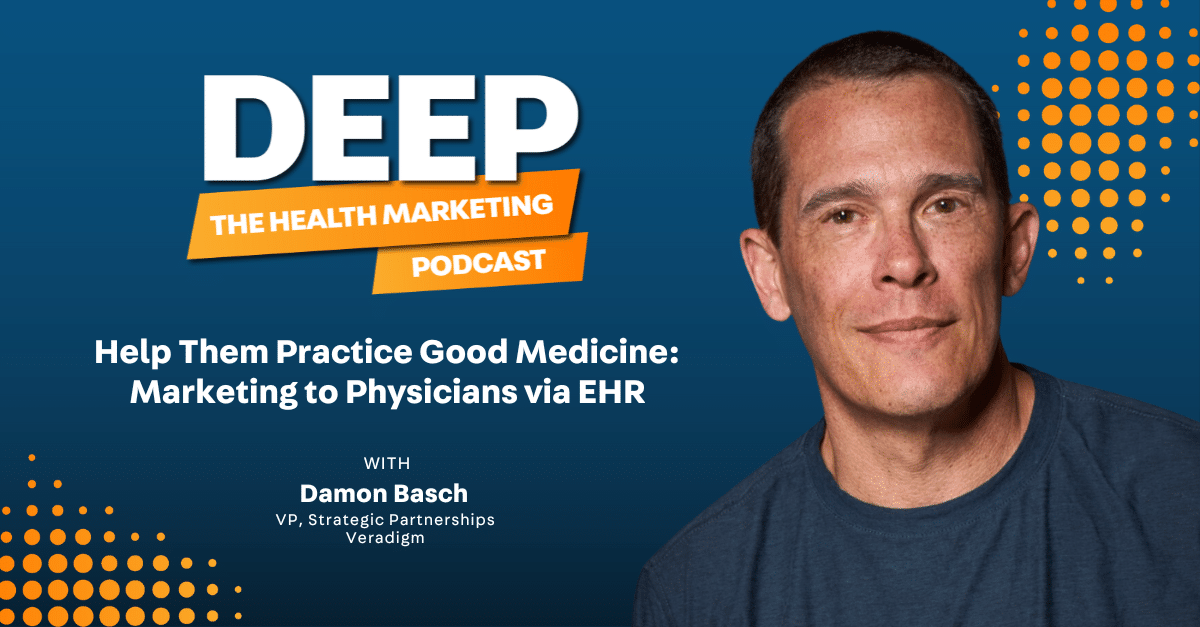
In this episode, John Mangano sits down with Damon Basch, a leader in healthcare provider (HCP) marketing and VP, Strategic Partnerships at Veradigm. Damon shares his journey to becoming an expert in electronic health records (EHR) and clinical workflow communications. With insights from over a decade in the industry, he discusses the evolution of healthcare marketing, the unique challenges of communicating with physicians, and the vital role EHRs play in enhancing patient care. Damon dives deep into the intricacies of marketing within the healthcare provider ecosystem, focusing on the importance of delivering timely, relevant information to doctors in a way that complements their workflow. He explains how EHR platforms have transformed over the years and why they're a critical touchpoint for marketers aiming to influence prescription decisions and improve patient outcomes. Tune in to learn about the most valuable ways to reach HCPs at the point of care.
Transcript:
John Mangano (JM): Damon, we focus specifically on how healthcare helps patients, because when it's all said and done, patients are people, and it's all about the people. But more importantly, we're all bigger than the roles we play. Before we get into patients and healthcare providers, where you're an expert, I want to get to know more about you. You have an interesting background — you're another self-trained chef, to some degree. Tell me about that.
Damon Basch (DB): I don't claim to be nearly as accomplished as Mike Caruso — he sounds like someone I'd love to join for family meals and holidays. But like a lot of folks, COVID left my family and me at home, fending for ourselves, suddenly having to figure out how to cook every night. Somehow along the way, I became the family chef — and, interestingly, also the person who cleans the dishes. I don't know how I ended up with both jobs, but I did become the family chef during Covid — good on the grill, good on the char broiler, good on the griddle, and good on the smoker too. Someday, if Mike and I get a chance to sit down, we can compare our favorite recipes — I'm sure his Italian recipes are fantastic.
JM: I keep trying to get myself invited to one of my guests' houses for dinner, but it never happens, so this time I'm not even going to hint — I'll just ask outright: when are we coming over?
DB: I'm in New York City — come on by anytime.
JM: Alright. Another thing I've heard you're very interested in is motorcycles. Tell me about that.
DB: There's the "before I had children" life and the "after I had children" life, and a lot of the daredevil activities were before. I rode motorcycles for about a decade, all over the country. I do miss those days of free-spirited riding, a little too fast for my own good, without a care in the world. These days I'm a girl dad — I've got two teenage daughters, one in college and one starting high school.
JM: Excellent. You've been in the healthcare provider marketing space for quite some time, and I always find everyone in this field came in through some unexpected path. What got you into healthcare provider marketing?
DB: Oh gosh, my origin story. I distinctly remember driving back from college with a liberal arts degree and no real discernible skills — because, well, liberal arts degree. My father was one of the original Madison Avenue "Mad Men" — an account guy who ended his career at Saatchi & Saatchi. When I talked to him about my career, he mentioned that account teams selling advertising had been calling him forever, and he'd noticed I had good written and communication skills, which to him spoke to sales.
Back when I was first entering the job market — and some listeners might relate to this — the primary way to find a job was the back of the classified section of your local newspaper, which for me was The New York Times.
There was a two-line ad for a medical publisher in New York City — a first-generation, family-owned publisher of medical newspapers. A lot of people in the industry I'm still friends with got their start at that company. At around 23, I got a job there, and the level of freedom I had to learn the business was truly extraordinary. I'd take my newspapers, fly to the Midwest, rent a car, and disappear for three weeks calling on clients. At the time I worked on an anesthesiology publication, but I also spent time in gastroenterology, pharmacy, retail, and other healthcare-related areas. It was just me, my newspapers, and my readership scores, calling on pharmaceutical companies and medical equipment companies.
But what really hooked me was calling on doctors — because in anesthesiology, a lot of the physicians are technologists, inventors, entrepreneurs.
I'd try to sell them advertising, using a Rand McNally map on my steering wheel — this was before mobile phones and the internet — driving with a highlighter, tracing routes from place to place, meeting doctors and brand managers, and loving every minute of it. Then I'd come back and actually read the newspapers — I'd copy-edit the monthlies for fun, because something's wrong with me — and I'd start to understand how the specialty worked, learn about the pharmaceutical side, why physicians preferred one product over another, what patient outcomes looked like. It was an early lesson in going deep in an area I was genuinely interested in — chemistry, biology, medicine, physician care.
Eventually, I felt there was a bigger world out there.
That's when I left for consumer publishing for a bit — I spent time at Food & Wine magazine, Family Circle, and a few others. They didn't resonate with me — I couldn't relate to the content, and I ended up missing both the internet boom and the mobile boom in the process. But EHR was in a really special place when I stepped back into healthcare. For those unfamiliar, around 2009–2010 there were government incentives paying physicians and practices to adopt technology — the Centers for Medicare and Medicaid Services, and the Office of the National Coordinator for Health IT, were incentivizing doctors to start collecting data, as part of the early shift from fee-for-service to value-based care. Doctors were adopting this technology at breakneck speed, not without turbulence.
I looked at that trend and really wanted to be part of it. I wanted to understand Health IT, understand the HCP experience with technology — that intersection, and what EHR and technology could contribute to improving the physician experience and patient care. That was about 12 or 13 years ago, and I've focused on that ever since. I really cut my teeth as a seedling on the road, connecting with the physician experience directly.
Fast forward 12 or 13 years, and I've worked across many parts of the business. But where I got my deepest education in HCP marketing was working on clinical workflow partnerships. As an EHR company, we have the unique benefit of an entire ecosystem of technology companies trying to deliver value to doctors — not marketing, but actual software products, solutions, and services. I got to know a lot of them, since they were all interested in connecting to our EHR to offer features and value for doctors. Through that process, I came to understand, at an even deeper level, what the HCP experience looks like — their practice, their patients, their pain points, the burden of care. That hooked me even more.
JM: A lot of people listening are DTC marketers who don't fully understand EHR the way you do. Fundamentally, the mechanism by which an ad gets served — is that the laptop your doctor is looking at when they're writing your prescription, or somewhere else?
DB: For the uninitiated: EHR and EMR — electronic medical record and electronic health record — are somewhat interchangeable terms. Physicians spend four to six hours a day using these software platforms to manage their practice, manage patient flow, write prescriptions, communicate with staff, sign charts, and submit bills so they can get paid. It's the most important piece of software they use — similar to how the rest of us rely on something like Outlook to manage our workday. So it's critical that these tools are easy to use, powerful, and — from a marketer's perspective — allow for effective communication within them.
It's ubiquitous at this point — every major health system, every doctor's office has some kind of electronic capture or practice management system.
They use it at night, on their PCs — going back to your original question — on their iPads, on their mobile phones, during what's sometimes called "blue jean" or "pajama moments," when they're not physically with patients but still doing the incredibly busy work of running a practice. And of course they use it while seeing patients too. So it's close to them — in their pocket, on an iPad, or on a desktop — virtually all the time.
As a marketer, if you're at all interested in communicating with physicians at what I'd call the bottom of the funnel — when they're actually diagnosing, making prescribing decisions, facing a patient, and making critical decisions — it's a mission-critical place to be. It's also the completion of the marketing cycle. Think about programmatic marketing — incredible tools for broad reach, measurement, sequential messaging, moving in and out of campaigns quickly, measuring constantly. All of that is important, but it's about pulling a physician through a journey to an endpoint, and that endpoint is really the point of care. The tip of the spear at point of care is the EHR. Being able to target and market effectively there is a critical part of an overall plan, and quite different from DTC in a lot of ways.
JM: As an expert in communicating with HCPs — they're a very different audience. What misconceptions do marketers have about what physicians like to hear, and what do they absolutely not want to hear?
DB: Physicians are looking for information that helps them practice good medicine. That means marketers have an obligation to understand them at a deep level — to deliver the right information at the right time, in the right moment of their practice, with the right patient in front of them. When that context isn't considered in an HCP plan, it becomes a disruption. That's exactly what we hear from doctors — you'll never hear one say, "I love advertising, give me more." That's just not going to happen.
But there are certain kinds of messaging and support they genuinely appreciate, and they tell us so. Think about the challenges they face day to day: keeping up with what's new, what's newly approved, new indications, new formulations, patient savings programs, how to get a drug authorized, how to reach a field rep, how to navigate market access issues. These are things directly relevant to their practice — even specifically relevant to a clinical encounter they're having with a patient right now. If you're thinking about a physician the same way you'd think about them on television — where you've reached them broadly — and applying that same logic to EHR, that's not an optimal marketing approach.
A lot of the education here is about connecting the dots between connected or linear TV, non-endemic print, outdoor, and all the other channels a platform like DeepIntent can deliver — but then thinking smaller at the bottom of the funnel. You think big at the top, but small at the bottom, because you have to be specific. That's what point of care does well — because of the data we have, how well we know our physician audience, and the care we take to deliver marketing in a way that's complementary, not disruptive, to their practice. That's really the "magic sauce" for doing it effectively.
JM: It's interesting — when I meet healthcare providers socially and they ask what I do, I never quite know how to answer, because a lot of them respond with, "Pharma analytics? What exactly is that?" The reaction really varies by person. What's the biggest misconception healthcare providers have about pharma and the pharma industry?
DB: That's a great question, because I think the misconception is that pharma wants to spend a dollar and make three by influencing physicians to write more prescriptions. I've called on hundreds, if not thousands, of brand teams and marketers, and you never hear them talk that way. What they talk about is the molecule — the actual brand — what it can do, why it's different, how it can help physicians with certain patient types. They talk about how difficult it is to get physicians the information they need to know when a specific brand or drug is appropriate, or how to prescribe it correctly. They're approaching it from the standpoint of solving problems. I've never heard an HCP marketer position their goal as simply getting a physician to write more of their therapy.
Now, the nature of the business is that we look at ROI, or return on ad spend, and the key metric we track is a change in prescribing behavior. But I don't draw a negative line to HCP marketing because of that. I think, by and large, we're trying to be on the right side of things here — trying to be specific, targeted, and use data to make sure we're giving physicians what they actually need. So yes, there is a misconception there, John, to be sure.
JM: And the interesting thing is, healthcare providers are as busy as they've ever been, and they'll be the first to tell you they don't have enough time to research new treatments and everything else they'd like to. So informing them is genuinely a service to them. Ironically, a lot of the research I've done shows that when you ask healthcare providers directly, "Are you influenced by pharma marketing?" the answer is almost always, "Absolutely not." So deep down they know they're the decision-makers, but I sometimes wonder if there's a bit of cognitive dissonance between how they react to marketing and how they see themselves — even though they are, ultimately, the decision-maker.
DB: They're also consumers, so some general marketing principles still apply — there's a familiarity that builds over time with reach and frequency, so that when the right moment comes up, it reminds them to think more deeply about that brand or medication.
We've been serving media on one of our platforms, Practice Fusion, for 12 years. As a bit of a sidebar — when we first launched, the platform was free, and for around $150 or so, a physician could opt out of receiving any ad messages. Less than 0.1% chose to. That's a testament to how carefully we made sure placements weren't disruptive to the clinical workflow, and that the messaging itself was genuinely targeted and helpful.
You're right that physicians don't have time to keep up with everything out there. They're also struggling — particularly independent physicians — just to make a living, transitioning from fee-for-service to value-based care, figuring out how to report to both commercial and government insurers, code things correctly, get things authorized more quickly, and get a patient to actually fill a medication, with cost being the biggest obstacle. Anything we can do through marketing to make their lives easier and help with those challenges is the right thing to do.
Physicians will never say "I love advertising, give me more," but I've heard many of them say things like, "This helps our patients afford their medications," or "This helps them connect with hub services, care coordination, or resources to manage their disease and pay for their medication." There are all sorts of resources pharma supports that are meant to do exactly that.
There's also a lot of above-brand marketing and support for HCPs. Right now, for example, we're in the middle of vaccine season, and most major vaccine manufacturers are coming to us and other point-of-care vendors with above-brand messaging — evidence-based guidelines about best practices for patients. It's a reminder, when you're seeing patients, to consider those guidelines. In our case, if a patient is missing a recommended vaccine, or missing the second dose in a series, we have the data to support that intervention, reminding physicians of the evidence-based, guideline-directed therapy. That's not branded — it's unbranded messaging from pharma companies trying to bring best practices to HCPs through effective HCP marketing. It's another example of the good that comes out of partnering with pharma.
JM: That's a great point. I'd bet if you surveyed a thousand healthcare providers, at any stage of their career, and asked what they looked forward to most when they started medical school, not one of the top thousand answers would be, "I want to run a small business, order refills of samples, and pay off equipment loans." But at the end of the day, they do have to run a business. And to whatever degree the industry can help them run that business, it ultimately helps them do what they actually want to do — which I'd bet, for nearly all of them, ranks in the top three: help patients improve health outcomes.
DB: A hundred percent. That's one of the reasons you're seeing so many independent practices get rolled up into private equity or large health systems — because running the administrative side of a practice really isn't what most physicians want to be doing. They don't want to be the CEO of their business; they want to practice medicine. Pharma definitely has a role in reducing some of that friction.
For example, a practice can spend eight hours a week on prior authorization, depending on the specialty. Specialty drugs that are expensive can go through a long prior-authorization review and approval cycle — they can get denied, you have to appeal — and meanwhile the patient isn't doing well. Pharma has teams of field reimbursement managers and market access teams, along with marketing resources — landing pages, destinations where physicians can find help reducing that authorization time, understanding coding, understanding a specific payer's process, or getting a patient enrolled more quickly.
That's very different from the kind of branding you see when you're watching Wolf Blitzer at night and seeing all those pharma ads — more generic branding, "here's what it does," disclaimers, and so on. But once you get useful at the point of care, pharma brings in all these other resources — some driven by advertising pointing toward a destination where those services are available. In an ideal world, it's working in concert with the field team and a host of other complementary services alongside that awareness messaging.
Marketers are getting more and more sophisticated about this, certainly on the HCP marketing side. What's interesting, though, is that we're starting to see demand from DTC marketers we've never seen before — it seems like people are trying to connect the dots from DTC to HCP, making that funnel even wider, in a sense, because that HCP is also a consumer. So now they're in a DTC funnel too, and somewhere along the way those dots are getting connected. I think a lot of that comes down to ad tech and MarTech capabilities that simply didn't exist a few years ago — identity graphs and device graphs that understand the physician's experience longitudinally, both as a consumer and an HCP, letting us guide them through a funnel far more meaningfully and precisely than before.
I also think AI is playing a really interesting role in the evolution of HCP marketing — and I mean that specifically through the lens of the physician experience, which is how I try to look at the world in general. A lot of marketers talk about AI in terms of audience quality and marketing-specific use cases, but I look at it more from the standpoint of: what new data comes out of new physician workflows and experiences that lets us be more specific, more supportive, and more effective for marketers?
One example — AI scribing is booming right now. Physicians don't want to be looking at a keyboard when they should be looking at you.
We're seeing a lot of companies focus on scribing tools that not only convert conversation into structured EHR data but also look for clinical signals — things like a potential rare disease that warrants more questions. It helps with diagnosis without diagnosing. But for the marketer, it also gives us signals. Take an Alzheimer's drug, for example: at point of care, we've always known when a physician is treating a patient with Alzheimer's, but we never knew whether it was moderate-to-severe or early-stage, or whether the patient had already tried and failed other medications. AI-driven workflow enhancements now give us more actionable data, letting us be far more specific for that physician — which leads to better care for the patient. HCP marketers absolutely play a role in that.
JM: That's a huge opportunity, because think about it — after a doctor's been practicing for 20 years, they don't necessarily have as much of a support network around them as you might think. They're seeing 50, a hundred, a thousand patients, and their experience is shaped by that, plus continuing education. But if you look at an EHR platform that spans not just doctors within a single practice, but practices across the entire country, AI could identify signals that show up elsewhere in the country, or even the world, that a given doctor may never have personally encountered. That gives them a much bigger toolkit to help their patients.
DB: The amount, quality, and variety of data is changing at breakneck speed — claims data, EHR data, registry data, social determinants of health, mortality data. And about 80% of the data in a clinical platform is unstructured, and now we're starting to structure it. We have rare-disease clients in pharma who tell us that, depending on the disease, it can take 8, 10, 15, even 20 years to actually get diagnosed. If you're a brand that has something to support that rare-disease patient population and improve an outcome, you want that patient diagnosed as early as possible. Data plays a huge role in that.
I have Ehlers-Danlos syndrome myself. I'm older, and I've had it my whole life, seeing multiple doctors over the years for different symptoms, but no one ever connected the pieces. It wasn't until a brilliant neurologist diagnosed my daughter with Ehlers-Danlos syndrome that we put it together and realized I was the carrier all along. There were signals all along the way, and if those signals can be interpreted — particularly by a marketer — you can show up at exactly the right moment in a much more meaningful way. And when you're talking to a physician about media and marketing, they're absolutely going to appreciate a message that genuinely helps them with that specific patient, based on data that's never been available before. That's what has to happen in HCP marketing.
JM: It all comes back to the patient. You went a lifetime with a condition, and that likely had an impact on what you did or could do — hopefully it didn't hold you back too much, but for many people, a condition really does change their life. Identifying and treating it earlier, or even just understanding what's going on, can be life-changing. That matters for all of us.
DB: Exactly. Another example — there's so much happening right now in cardiometabolic disease. You have drugs originally developed for diabetes that are now being used for cardiology conditions, and also for chronic kidney disease. So now you've got a cardiologist, an endocrinologist, and a nephrologist all treating the same patient, with related symptoms and overlapping treatment options. As a marketer, you've got three different indications for a single drug, all potentially connected to a broader syndrome, and you have to figure out how to use data so that when all three physicians are treating the same patient, they can actually connect those dots.
It's another example of how data is changing the game for HCP marketing — quite different from the top or middle of the funnel, where reach, frequency, and efficiency matter most, and where you're pivoting and driving certain behaviors down toward that point-of-care conversion. Once you're there, you have to elevate your game, and thankfully the data is there to support that. I do think pharma is still trying to catch up on ingesting all of this new data — as are the ad tech and MarTech players — because no one really anticipated all this data becoming available, and yet here it is. That's exciting to me.
JM: What are the three biggest opportunities you see in healthcare provider marketing over the next 24 to 36 months?
DB: First, AI-driven workflows for patients and providers are going to generate a data exhaust so rich that we'll be able to provide resources more specific than ever before — and we'll need to connect that data across the ecosystem. For example, if we learn at point of care that a patient is starting a new, expensive therapy, HCP marketing needs to connect the awareness that drove that action to actual follow-through from pharma — getting a field reimbursement team involved immediately if a physician has just submitted a prior authorization for an expensive specialty drug, helping onboard that patient and get them their medication, going that final mile.
Second, there's a lot happening in interoperability — systems being required to communicate with other systems to pull patient information and data. That represents real opportunity to connect the dots in the patient or physician journey. The ability to pull data from everywhere, all the time, is changing very quickly.
Third, I'd point to the sheer number of players in the market right now — it's a "red ocean" out there. That tends to drive innovation at breakneck speed and pushes the best innovations to the top — around audience quality, AI and machine learning, and better ways to reach both providers and patients more effectively. This crucible we're in right now, with identity graphs, device graphing, and better data, is driving real excellence in HCP marketing — but it's noisy out there. Really noisy. I'm looking forward to seeing how the cream rises to the top through all of it.
JM: If you could travel back in time to when you started in healthcare provider marketing, what three pieces of advice would you give your younger self?
DB: Go into private equity — I'm kidding. Three real pieces of advice: First, do it for the right reasons. People in HCP marketing genuinely care about it, and that requires going deep. The good news is it's a real community — the people I called on when I started as assistant media planners at agencies are now presidents and CEOs of those same agencies. So I'd tell myself to network as much as humanly possible, because in this world, you really can get to know most of the people making a meaningful difference in it.
Second, read everything. I read everything on Health IT, everything on national policy related to it, physician blogs, and I talk to our chief medical officer to understand his experience. Being an effective HCP marketer requires relatability. What's tempting, especially with programmatic buying, is that you're working off an extremely powerful platform that lets you identify audiences, jump in and out, measure, and move — but it's very NPI-centric, thinking in terms of NPI eyeballs rather than understanding, at a personal level, what the HCP actually experiences. I think it's especially important for programmatic buyers to pause and try to understand a perspective beyond just NPIs, reach, and frequency. It'll make you a better marketer overall, and you might find it genuinely interesting.
JM: Damon, what's the final piece of advice you'd give to anyone entering this business?
DB: There are so many great resources in our world now — every agency has a point-of-care marketing practice, an EHR center of excellence. There's the Point of Care Marketing Association, the Digital Health Coalition, the conferences we all attend — and it's all available online. It really comes down to immersion, like learning a language: go as deep as you can. My advice is not to be afraid of that, and to take advantage of all those resources. And I'd invite anyone listening today to reach out to me directly if they have questions about point of care — I try to be one of the people in this industry who shares and grows alongside others. I'm happy to keep the conversation going with anyone who found value in this.
JM: That's great advice, and a generous offer. Thank you, Damon.
Links
- Damon Basch on LinkedIn
- Veradigm
- Practice Fusion
- Point of Care Marketing Association
- Digital Health Coalition