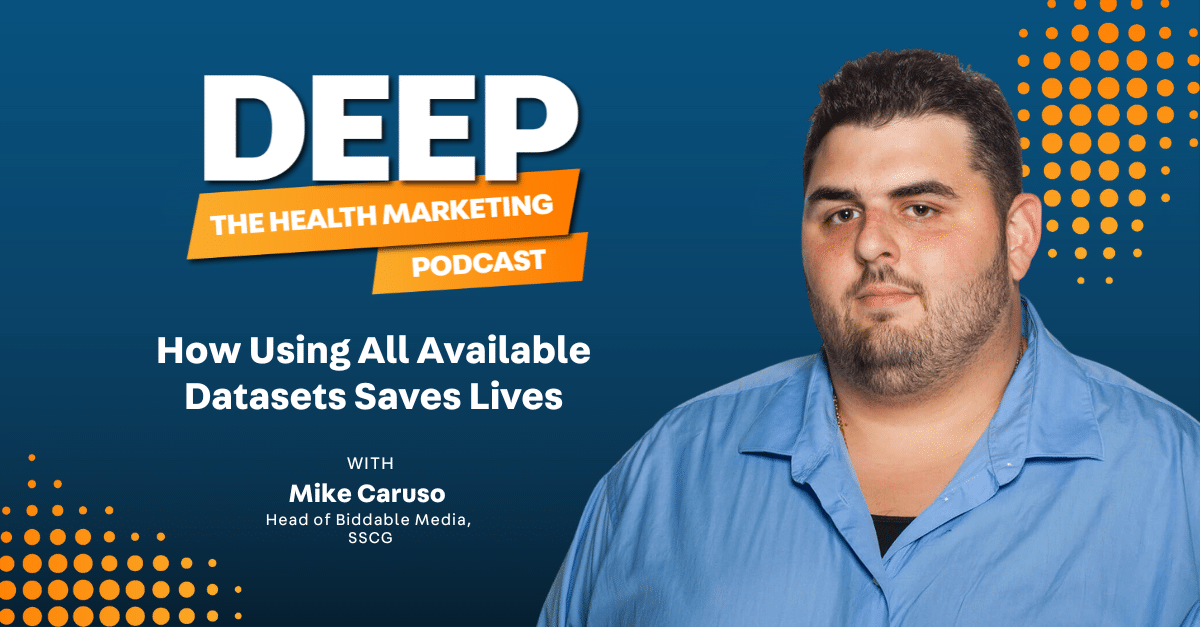
In this episode, John Mangano sits down with Mike Caruso, the Head of Biddable Media at SSCG, to discuss the evolving landscape of health marketing, focusing on integrated data solutions, developing partner relationships, and the AI-focused progress achieved by his organization. Mike shares insights into how his team is leveraging data and technology to create innovative solutions for their clients, aiming for higher success rates and better health outcomes.
Transcript:
John Mangano (JM): Hello, welcome to the Deep Podcast. I'm John Mangano. The advertising industry as a whole is wrestling with data — it's always wrestling with data: data quality, data provenance, privacy, integration, and data ownership. In health marketing, all of these concerns are magnified when it comes to advertising data. There's no sector with as many constraints and regulations, and so much at stake in the form of people's physical and mental wellness. Health marketing simply has a different kind of impact, because making the most of the best available data sets isn't just good marketing — it can save lives.
My guest today is a thought leader in the unique world of biddable media: Mike Caruso. For Mike, every audience and media challenge is an opportunity. Mike leads Biddable Media at SSCG, one of the world's largest full-service, pharma-focused media planning and buying groups. Mike, thanks for joining the podcast.
Mike Caruso (MC): Thank you for having me on the show. Appreciate it.
JM: Before we go deep, I hear you're quite a chef. Tell me about that.
MC: I'd consider myself a home chef, not a technical chef, if that makes sense — basically, I can make it taste good, but I can't make it look pretty. That's kind of the extent of my chef qualities. I have three kids, all under 10 years old, so my life is chaos both in and outside of work, but it's a fun chaos on both fronts.
The food industry has always been a big part of my life. My parents were always involved in it — my mother had a bakery on Long Island for many years. I come from a deep Italian background, if you can't tell by the stereotypical accent I'm displaying right now. My great-grandfather started the San Gennaro Feast — my whole family is from Mulberry Street, and we've always had a family member running a stand there. I like to eat, and I try to keep my kids to the same standard when it comes to food — we don't like picky eaters in my family, let's put it that way.
JM: That's great. What's your go-to?
MC: I like to get outside my comfort zone a lot. I mean, obviously I have all the Italian recipes, and I try to stick to them as much as possible — love a good pesto sauce, love a good vodka sauce, something basic and traditional like that. But I've really been trying to branch out. I've been cooking a lot of Korean food lately, trying to learn different Asian dishes.
I also do a crawfish boil every year. I went to school in New Orleans — Loyola University — so I fly in live crawfish from New Orleans every year and do a big cookout, a traditional New Orleans-style crawfish boil with all the fixings. I also used to live in Austin, Texas for a couple of years, so I have a huge offset smoker where I smoke my own brisket and ribs. I can go pretty big sometimes.
JM: I think you're going to be someone I need to get a lot closer to.
MC: That's it — you've got to come over.
JM: Maybe we can trade some of my Nana's recipes for yours.
MC: I'm all about it.
JM: Alright, so let's talk about media. You're the Vice President of Biddable Media — a role that's very specific, and one I'm not sure would've even existed 15 or 20 years ago. So I suspect this isn't what you set out to do. How did you find yourself focusing on biddable media in healthcare?
MC: Yeah, that's correct — this is definitely not what I envisioned doing when I was in college. I went to school for advertising and journalism, part of a mass communications program — journalism and graphic design, and I basically did both. My goal was either to be in front of a camera on SportsCenter or to create Nike ads. That was the goal.
But post-graduation, when reality hit and it was time to find a job, I moved to Austin and started working at a creative and website development agency, on the account team, QA-ing WordPress and Drupal sites and things like that. As an intern, I noticed there was a niche around search and analytics, and a couple of mentors at the time basically told me, "This is growing — you should try to get certified in it. It could result in a full-time job." So that's what I did.
I got certified and positioned myself to be more advanced in that area than anyone else there — not because I was especially advanced, I was still very junior, but no one else had gotten certified. I used that as leverage to land a full-time position. The first campaigns I worked on — I've touched a few different verticals, but the ones that were search- and analytics-focused at the start were actual pharma accounts. That was my introduction to this industry from a hands-on perspective, and I never looked back. It's always been genuinely interesting to me — both the biddable/analytical side of things and the pharma industry itself. I think it's a unique industry, and I think it sometimes gets a bad rap.
JM: It's funny you say you started in journalism school — I did too. I find some of the best analytics and media people started off thinking they'd be writers or reporters, and in the end, it's our ability to tell a story with data that makes us stand out, and then we catch the analytics bug and end up in a role like this. I've got a few people on my team who are literally J-school grads, just like us. Have you come across a lot of J-school grads in this field?
MC: Yeah, a couple. But to your first point, I think it helps immensely in our industry. When I first started, one of the hardest things I saw people struggle with was how to tell the story — how to communicate well. Even little things, like in college being in front of a camera, reading stats. When I was still in college taking journalism courses, I did a lot of prep football radio in Louisiana — high school football is no joke down there. It's similar to what we do day-to-day: you need to tell a story with data. Back then, that data was stats — which wide receiver had the most yards on the team, what their records were. But how you tell that story matters, and I think that background helped me with the part a lot of people find most challenging coming into this business.
In my experience, analytical people aren't always behind the scenes — they have to talk to clients, they have to present. There's sometimes a preconceived notion that if you're analytical, you're always behind the scenes, buried in Excel all day. But the people who have the most success in this field — whether in biddable media or analytics — aren't just executing or looking at data, they're also able to communicate it effectively. And I think journalism helped with that.
JM: Definitely — I use it every day. What are you focusing on right now that gets you excited?
MC: My biggest focus right now has been growing our partner relationships — whether that's on the DSP front, with our social partners, or our search partners — and working on custom solutions. What data sets do we have available? What do our partners have available? What can we put together, or is there a new way to plan or activate that we've never done before? What can we do for the first time on behalf of our clients that will give them a higher degree of success? I'm proud to be working on that, and I know we have things happening across many of our partners.
More recently — over the past year and a half or so — I've also been leaning into staying on the bleeding edge of AI and tech developments, and understanding how that technology can help us in the pharmaceutical industry.
Omnicom Health Group, and SSCG as a whole, has really tried to stay ahead of it and spread education on where we think it can impact our business. We've created our own AI blueprint for how our internal business uses it. We've also done a good job spreading education, not just internally across departments but externally with our clients, to show that there needs to be a better understanding of AI. A lot of this has actually been happening for a long time — it's just getting attention now because it's a buzzword. Biddable media has been using AI for a long time, whether that's basic machine learning or more generative AI now.
I'm proud to be on the forefront of that for our agency. Myself and a few others at SSCG — like our Chief Innovation Officer, Rosha Matthews — have rolled out an AI education series, both internally and externally, covering how we use AI in different ways: for planning, for research, for activation. We've tried to break it into digestible pieces to show where it can make an impact for media, for healthcare, and so on. I've been happy to be doing more of that work over the past couple of years.
JM: When I think about my father, who started his career as a marketer in the sixties — his world was entirely different. Not too long ago, I walked him through what I was doing for a client he happened to have worked for his whole career — it was all about internet trends and what brands were doing online. Afterward, he confided that he understood the analysis and the brands, but he had no idea what the metrics actually meant. And that wasn't even tied to AI — that was just old-school internet metrics. AI would really blow his mind, even though he was originally a statistician.
I think it's safe to say most people in the latter half of their careers don't know what we'd even be talking about — it's completely foreign to them. It's not a world of GRPs anymore; marketing has changed dramatically. Can you explain what biddable media is, and how AI ultimately impacts it and other marketing, compared to what someone at the tail end of their career might have experienced over the last 30 or 40 years?
MC: Yeah, that's a great point, and it's a definition that's evolving across the industry in general. In the simplest form, biddable is exactly what the name suggests — auction-based media placements. You're bidding in real time against competitors for similar targets and audiences.
I lead the biddable department at SSCG, which includes paid search, paid social, programmatic, and any kind of online video or CTV. We've also organized organic search under biddable. Why would you do that, since organic search doesn't carry paid media spend? Because once you understand how biddable works — how it's based on relevancy and relevancy scores — you realize that integrating the organic side of search with the paid side adds a lot of value.
So it makes sense to have that structure, with those teams working closely together under the same department. But I think the main difference compared to 30 years ago is that there are no guarantees in biddable. There are no hard commitments, no contracts that can't be broken. You have a certain level of flexibility in how you organize and structure your buys — to the point where you can watch the data come in and manage those buys based on how well they're performing.
That wouldn't have been possible 25 years ago, because we didn't have data coming in that fast, and we didn't have that level of near-real-time measurability. Think about how fast it all moves — you set up your targets, whether for programmatic, social, or search, you set (or automate) your bid amounts, and in milliseconds the algorithm identifies who the target is, what you're willing to spend, how relevant you are, and then serves an ad — yours or a competitor's — based on that, all in the blink of an eye.
So I'd say the biggest differences are the lack of guarantees and the speed at which it all happens. That can be a pro or a con, depending on whether you know what you're doing. If you don't understand how to set up campaigns and align relevancy with creative and targeting, you'd be better off with a fixed commitment or guarantee — otherwise you'll get bad performance and pay more than you should. Learning how to do it the right way is extremely important.
JM: Let's double-click on that. We're talking about media and health, and of course a large piece of health is pharma advertising specifically. I'm old enough to remember before there was an internet to market on, and before pharma was marketed the way it is today. Now, when you look at the king of media — television — it's going through a huge change. We have CTV now, which of course is biddable media. How do you see that shift impacting our clients, and ultimately their ability to reach patients in a way that helps their health?
MC: I only see it as a positive. Take CTV as an example — you're moving away from something that was more "pay and spray," requiring a lot of money to do at all. We have very large clients at SSCG and Omnicom Health, but we also have mid-tier clients that don't have traditional TV budgets. With the shift from linear to CTV, you get much cleaner data, and you're able to use certain platforms — a DSP platform or a custom study — to actually see clinical-effectiveness metrics tied to message exposure.
So even without a big commitment — maybe with a smaller budget for a mid-tier client — you can still get that same kind of broad awareness play, but to a much more targeted audience, with near-real-time data coming in.
I think it's a huge game changer — I don't see it as a negative in any way. Across any biddable media type, the common denominator is relevancy, and I think CTV offers that just as much as search or social. When you think about the targeting available, and how you can curate it — even from CTV partners like Roku or LG — they're developing curated playlists you can sponsor. So beyond the targeting side, on the content and creative side, they let you choose content in their video library that speaks to your audience and sponsor it accordingly. You get advanced backend targeting to reach your audience, but you can also work on the front end with creative sponsorships that align with that audience. I don't see that being possible with linear TV to the same degree.
JM: It's interesting — right now we're talking about CTV, and I see a lot of parallels with digital media. I remember when "digital" didn't even include mobile devices for the longest time, and then there was a period where digital and mobile marketing were treated as two different practices, often managed separately. Now nobody really distinguishes mobile marketing from digital marketing — it's just digital marketing. When we look at television, we're talking a lot about linear TV versus CTV as two very different things, but probably in the not-too-distant future we'll just be talking about "television" again, regardless of how it's delivered. Right now, though, it seems like the data is scattered everywhere. What does the future look like as we integrate that data and pull it all together?
MC: Yeah, I think it's true across all formats, not just CTV. I've been to a lot of industry events this year, and in the CTV space especially, nearly every panel and session from leaders in the space has focused on the fact that it's too fragmented right now — that's the thing everyone's trying to solve. It makes sense, because the less fragmentation you have, the cleaner your data inputs and outputs are, and the better your measurement and activation will be.
Even outside of CTV, just look at the DSP space — in the last two years, look at how many more formats have been integrated. A year and a half ago, EHR data started coming in. CTV has grown not only on mainstream DSPs but on healthcare-specific DSPs too.
More and more CTV inventory is becoming available on the DSPs we use every day. Audio partners like iHeart have integrated as well. The more formats that get integrated, the more it plays into the beauty of biddable I mentioned earlier — it lets you consolidate your buy across formats, channels, and placements, and optimize in a very fluid way, in near real time, based on data outcomes you probably couldn't have seen five years ago.
I think there are two kinds of integration: format integration, which I just described, and audience integration. For us, that means patient and HCP audiences. If you can communicate effectively to clients and show them that consolidating buying platforms across audiences — having patient buys and HCP buys in the same place — gives them a more holistic view of the brand, that integration leads to better outcomes, whether for measurement or activation, and lets you optimize both sides for the greater good of that holistic brand view.
JM: Ultimately, we do all of this to help the patient, and success is usually defined pretty specifically — as more patients getting healthier, whether through treatment or condition awareness. How does this integration ultimately maximize the number of patients who get well, or get cured, whatever the condition is we're marketing for?
MC: Anything that helps serve more relevant messaging to the right people is going to help overall health outcomes. There are roughly 300,000 to 350,000 people in the US alone who unfortunately die each year from treatable conditions — that shows the need for effective communication. I think healthcare is different from most industries in that what we do day-to-day, if our marketing and media strategies are correct — whether that's disease-state education or product-treatment messaging, delivered to the right person right after they've been diagnosed, or informing HCPs about a new advancement in biomarker technology they should be aware of — leads to better health outcomes. Our job is to make sure it's relevant; serving the wrong message to the wrong patient doesn't help anyone, and it probably causes a negative reaction toward the brand.
But if you use integrated platforms and integrated data sets to reach the right target at the right time, you'll not only get better sales or scripts, you'll get better health outcomes for the general public. That can only help the greater good, and it's really why I love the pharmaceutical industry from a media standpoint — it's different from selling shoes or working in hospitality. Not to knock those industries, but what we do actually affects public health.
I also think, to some degree, it makes you a better marketer. It's a different kind of media play. If you're working on a hotel brand, the main KPI is the same no matter the brand — bookings, tied to e-commerce, with a direct return on ad spend every time. That's consistent no matter the client.
In healthcare, it's completely different. First, is the audience a patient or an HCP? Second, what's the patient population for this condition — is it 5,000 people in the US or 250,000? You're dealing with different audience sizes depending on the maturity of the brand. If it's a new product launch, maybe you're doing a mass-consumer, mainstream approach. If it's a brand that's been on the market for 15 years, maybe you're doing lower-funnel tactics.
So there are a couple of satisfying things here. The first, and most important, is that we're affecting health outcomes. But also, from a broader marketing-industry level, I think healthcare gets a bad rap because people don't understand how creative you have to be strategically — the data doesn't always come in as easily as in other industries, and configuring a strategic plan is hard and different every time. That's why I love it. I like to bring it back to being the token New Yorker here — it's like they say, if you can make it here, you can make it anywhere. I feel the same way about healthcare marketing. Most people don't face the same regulations or the same challenges with data that we do, and we get to strategize something different for a different brand every time.
JM: It's funny — you've mentioned a couple of times how pharma marketing sometimes gets a bad rap, and we've both seen it. I sometimes wonder if it's simply the sheer volume of marketing and advertising we all see. But when you think about it, we're both marketers who learned our trade, or were at least schooled, in journalism — it's all about communication, telling a story, and influencing people. The marketing that's out there is communicating with patients, educating them in a different way. It may not be a story The New York Times would run, but fundamentally it's getting people to talk to their doctors about their conditions.
We're not selling shoes — when people buy shoes, no one's going to tell them not to. But patients have to talk to their doctors. It doesn't really matter if they're self-diagnosing or asking about something that may not even be what they have — their doctor will make sure they get the right treatment. But fundamentally, that conversation is the most important part of getting treatment. So in many ways, what we do is a mix of advertising, education, and even a bit of journalism — and that helps people.
MC: And you need to do it across at least two, usually three, different audiences. We want patients to be informed and to bring up whatever they're concerned about, or whatever they've heard, to their doctor. We also need the doctor to be informed. So you really need a marketing mix across audiences, tying the story together so both sides can have the right conversation — one that's relevant to the condition and helps determine whether that product is actually eligible and appropriate for that patient.
The third side, which doesn't get talked about as much, is the insurance and payer side. You also have to work that angle, to make sure there's actual access to the product if that whole conversation plays out and the patient can get on it. So going back to why most people would say it's hard — it is a little more difficult than most other industries. But that's also why I like it. It's not easy.
JM: And we sit in one of the most precarious spaces when it comes to privacy — healthcare and internet activity are both very sensitive categories, and both are actively being scrutinized by state and federal regulators. What excites you about these changes, and what concerns you? Are we creating an environment where privacy is protected, and will that ultimately have a positive or negative effect on people's health?
MC: To some extent, I have full confidence we'll always be in a secure privacy environment, because we have to be — this is healthcare. In other areas of media and marketing, we might be a year or two behind on things like cool placements or mass-media buys, but when it comes to data privacy, we're cutting edge. The data is so personal that it has to be protected at all costs, and that's not new. Any data provider we work with, we vet carefully — and in the vast majority of cases, they've been doing this a long time and understand how important it is to keep data protected.
Where things are newer is around state data-privacy legislation — more comes out almost every week. Omnicom Health Group and SSCG have made a point of staying on top of those laws, understanding them, and vetting our partners to hold them accountable — essentially telling them, "If this is your industry, we expect you to stay current with the latest regulations." But that doesn't mean we shouldn't check ourselves too — we're constantly analyzing what's cookie-list-based and what isn't, what can be done at the geo level, and whether upcoming state laws will require manual changes on our end or will be handled automatically at the partner level. There's mutual accountability on both the agency side and the partner side.
I don't buy into the idea that we won't figure out a solution, or that data will become so restricted we can't effectively market and communicate with patients and HCPs. I think the technology is at a level where it'll be possible to do this to the same degree, if not better, and the overall outcome will be more positive and safer, in a way the public is more aligned with. From a cookie-less perspective, we're looking at all the available options — privacy sandboxes, alternative IDs, first-party feeds from first-party publishers. There are a lot of options right now. As cookies fully go away, I think those options will narrow down to whichever alternative ID or solution has been adopted by the most publishers and partners — the most scalable ones will stick around, and the rest will die out. That's speculation on my part, but that's what I'd expect.
JM: And the optimism is great. So if I could sum it up in one sentence: all these privacy changes will ultimately be a net positive for consumer privacy needs, and a net positive for patients, who are ultimately the same consumers with their own health needs. Is that fair?
MC: Yeah. And something we've been focused on for a while now is looking beyond just the "NPI list" — recognizing that these are people, not just conditions. A rheumatoid arthritis patient isn't just a rheumatoid arthritis patient — they have other hobbies and interests. A rheumatologist isn't just a rheumatologist. So we've been using other data sets in our roster to understand consumer signals — what are their mainstream consumer behaviors, what contextual signals exist outside the healthcare data — and overlaying that with health information to inform our messaging, placements, and channel preferences.
That's been really helpful for getting better insight, both pre- and post-activation. Healthcare data is highly personal — it's very important to protect it, keep it safe, and use it responsibly for planning. But there are other data sets that don't get used as much, and they can help too.
JM: Absolutely. I've had experience using non-health data that turned out to be very indicative for a brand I was marketing. We found that people who go to casinos tend to be more likely to have COPD than those who don't. A lot of people worry that without health data, there isn't much we can do — but demographic data can get us pretty far. I'm a redhead, I grew up in Puerto Rico and Miami, which was fantastic for everything except my skin. It's easy to infer that I'm more likely to develop a form of skin cancer than someone who grew up somewhere much less sunny — that's logical, and it would be a very indicative data point about where I came from and, in this case, a genetic predisposition.
That would be a strong data set to target against. A lot of what we do is based on things like that — even using a seed group from a health data set to identify trends, you end up acting a bit like a doctor who, over years of experience, learns that someone with certain features who grew up somewhere sunny, loves the outdoors, and has fair skin is more at risk for a certain condition. That's the kind of insight we can get from data sources that have nothing to do with health data directly.
MC: If it informs anything, it's helpful — that's the key thing to understand. Through some of our proprietary tools on the Omnicom side, we can easily see what over-indexes for a given audience. That's extra insight — maybe you don't even use it as a targeting segment, but maybe your creative for a skin condition features a redhead. Maybe it influences something outside of the activation itself, but it helps the message resonate with the audience your brand is trying to reach. It can only help, and it's something not everyone is doing.
JM: We talk a lot about the unknowns and the doom and gloom around privacy and ad tech changes that could affect us — but let's set that aside for a moment, because with all this change comes a lot of opportunity, and I hear a lot of optimism from you and others in the space. What are you seeing over the next two to four years that gives you real optimism?
MC: I don't want to give too typical an answer, but I think AI is still going to change a lot. I think it's going to create a much more diverse landscape of placement opportunities. Beyond the data itself, AI is becoming so mainstream, so quickly integrated into everyday products, that I think it's going to translate into new media opportunities that didn't exist before.
Take wearables — connecting to AI to identify new health patterns and inform patients. That's not a media placement today. But if your vital data can be tracked in real time, sent to your device, run through AI, and used to flag something you should look out for, and then that connects directly to a telehealth call — somewhere along that chain, there could be a media placement.
I think that's going to happen more and more — smart home tech, wearable tech, even Q&A interfaces. I've worked with big tech companies on the search side, and looking at what they're doing with their AI products, and how conversational and human that back-and-forth feels — ad placements can't and shouldn't try to mimic that same experience. Working with them on what the future of that looks like will be interesting.
I think AI will influence data, targeting, and analytics — that's already happening to some degree — but I also think the media landscape of placement opportunities and channels is going to get more diverse, which means you'll need to be smart about which ones you choose, since everyone has a limited budget. I think that's coming sooner rather than later.
JM: There's so much advertising in this space, in pharma and overall, and I know I'd rather see one very relevant ad than three ads that have nothing to do with my interests. Ultimately, that lets the viewer see fewer ads, and makes those ads more impactful — which matters.
MC: Yeah, we've heard it for a while now — personalized treatment, personalized medicine, and personalization through AI. That level of personalization is happening on all sides: on the media side, with publisher companies and tech partners, and with pharmaceutical companies trying to figure out where they can become more personalized and resonate more — not in a salesy way, but in an informative way, spreading education about a treatment or a condition that really resonates with that person at a one-to-one level. AI is kind of a supercharger to get us there. I know I keep saying the word, and I'm not trying to be trendy — I just think it's genuinely different in how it's being used now compared to three years ago, and it's going to make a real difference.
JM: I agree. I also think there's a lot of opportunity when it comes to rare conditions. True story — my sister had an extraordinarily rare condition, and the only way she was ultimately able to figure out what was going on wasn't through the doctors she was seeing, many as there were, but through researching online and finding a community of people who had the same condition, knew the treatments, and understood what it was. Doctors didn't know, because they'd never seen a patient with that condition before.
Creating that community — people knowing they're not alone — and getting that information to people with rare conditions is even more important, whether through communities or marketing, because these are the people who need help the most. People with high cholesterol will get diagnosed — that's common, doctors will catch it. But rare conditions need that kind of specialized support and community so people don't feel alone. Not being able to get a diagnosis is incredibly frustrating, and it often leads to depression and anxiety because of that isolation. Through AI and very specific targeting, I think we can help solve this, and brands can actually reach those patients and connect them to a solution that leads to better health. In many ways, I think those are the brands that should be marketed the most, because these are the people who get overlooked and have the hardest time finding the treatment that will help them.
MC: Yeah — we work on a lot of rare diseases at SSCG, so we have a ton of experience there, and I think you're a hundred percent right, based even on your sister's example. We see two things in that space. First, communities finding each other is hugely important, like you said — social channels often index very high, whether that's Reddit, private Facebook groups, or other online forums where people talk to each other about their challenges.
Second, we see that these patients often don't get taken seriously at the doctor's office, generally for two reasons: HCPs may not have much experience diagnosing that rare condition, so sometimes they brush it off. Or, because so few patients present with the condition, HCPs may not know how to test for it — and they may not always admit that. So from a media, messaging, and communication standpoint, for a pharma brand with a relevant product, test, or disease-state education, it's important to hit both sides. If you reach the right potential patient with your message, but they walk into the doctor's office and aren't taken seriously, and get sent home — you haven't actually done your job. You need to inform both sides: HCPs should be screening or testing for certain biomarkers, or recognizing that a certain symptom pattern that doesn't show up clearly in lab results might point to this rare disease.
That's a great example of needing the right tech to get the message out, while also understanding, from a consumer-usage standpoint, which platforms rare-disease patients are most likely to use — is it heavy on search because they have a lot of questions, or are they on Reddit and online forums communicating with each other? And on the HCP side, what will make them think, "I never thought of that — I should look for this when a patient comes in with these symptoms."
It's one of the most challenging spaces, honestly, because — given HIPAA compliance rules — you can't target one-to-one. You have to work with a modeled audience of a certain size. But these patients are out there, they're online, and it's so important to reach them, because some of these conditions are truly severe. It's a great example of using data and technology, and thinking differently, to reach the right audience.
JM: To close this out, Mike — we've covered a lot: privacy changes, technology changes, and even capability changes that AI is bringing that haven't existed before. So, bottom line — will patients end up healthier because of all this, or could it negatively affect their health?
MC: I don't think it'll impact things negatively. I think it can only help better inform the public. There are data restrictions and new legislation that make our job harder, but my resounding belief is that the technology will keep improving faster than the restrictions can slow us down. I think there will be better opportunities to effectively communicate with patients, which should lead to better health outcomes — and I think that will be more technology-driven than in the past. So I don't see much that's really holding that back, other than the cookie situation — and I think that will get solved. We may have to lean on a few more data sources than we're used to, but overall, I think it'll work out.
JM: Great. We talked a lot about integration — for those listening, since everyone will likely start seeing integration in the market regardless of which platforms they use, what are the three things you'd recommend people look for in integrated packages as they start pulling their data sets together?
MC: The things we vet for when working with partners: First, is the data safe? Is it protected? Is it clean? Is it based on first-party opt-in, or some kind of cookie-based solution? We have questionnaires built into our RFPs to ask those questions. Second, what's the level of customization allowed — can we bring in our advertisers' or brands' first-party data? Can we bring in proprietary data sources our research team may have, or that Omnicom is privy to? How can those be merged in a compliant, safe way? What technology is the partner comfortable working with to ensure that — is it clean-room technology, some kind of ingestion system that ensures everyone retains ownership of their own data, and that it's only used for a specific, compliant purpose?
So privacy is a big piece. But also, when I'm working with any partner — whether it's DeepIntent, a social platform, or a search platform — it's about asking, "What do you have that we don't, and vice versa?" With any partnership, you're trying to figure out what you're each missing, so together you get a one-plus-one-equals-three outcome — that added value. So when I think about integration solutions or platforms, or how to better integrate across audiences or channels, it's really about identifying the benefit, and where merging those data sets makes sense — and where it doesn't.
It's similar in the programmatic space — I have to remind people sometimes that programmatic isn't a channel, it's a buying method. Just because more and more placements become programmatically available doesn't mean we should always buy them that way. At SSCG, we analyze channels or placement types that historically were direct-IO and have since opened up to programmatic buying — what are the differences? Is direct better for scale or measurement? Does programmatic offer better creative flexibility, or automated activation without a contract? We've done a lot of analysis on these newly integrated channels and placement types.
The answer isn't always the same — it depends on the partner, their current programmatic capabilities versus their historical direct capabilities, and it can also vary brand by brand, based on what that specific client is trying to achieve. So with any partnership, or even planning a buy, you need to take that deeper step of weighing the pros and cons — and with partners, analyzing what gap they can fill for us, and what we can offer that makes them better. That's what I've enjoyed working on lately, and it's been great having honest, frank conversations with partners like yourself: here's what we have, here's what we need, how do we get there to improve our clients' success — or to help create better health outcomes for patients. That's what I'd say.
JM: I love that — programmatic isn't a channel, it's a buying method. Well, thank you, Mike. This has been Deep.